
Object Details
Manufacturer
Hughes Aircraft Co.
Summary
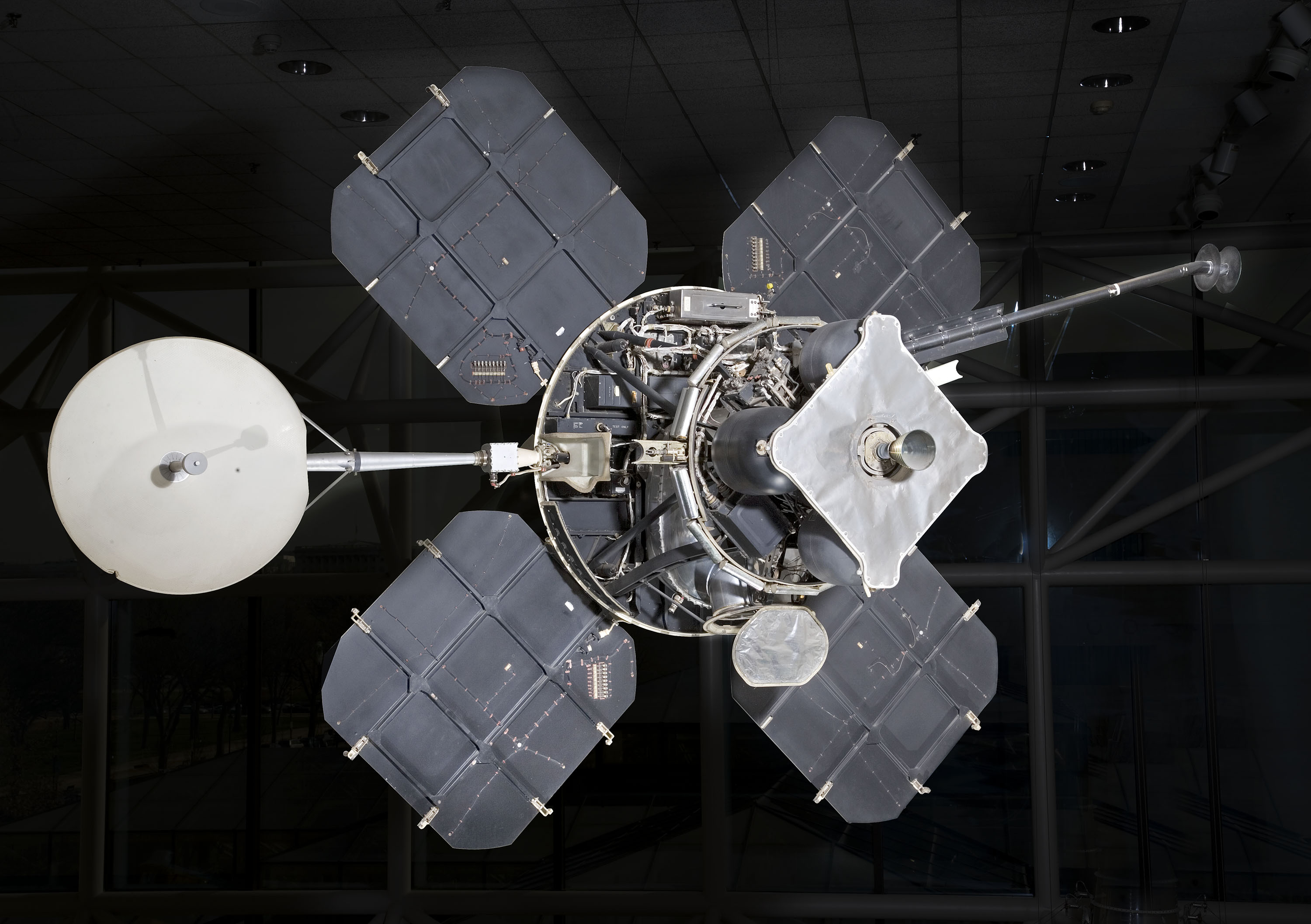
This Alpha scattering experiment is representative of those carried on Surveyor 5, 6, and 7. These spacecraft, launched starting in 1966, were used to survey the Moon's surface to help select a safe landing site for the Apollo lunar landings. This instrument was designed to provide information on the elemental composition of the lunar soil and rocks. The box, which contains a curium 242 radioactive source and alpha particle and proton detectors, was lowered onto the surface via a nylon cord; it could be repositioned by means of the surface mechanics sampling arm. Alpha particles (helium ions) from the curium source back-scattered from the surface, as well as protons produced by the radioactivity were then analyzed by the detectors. The relative amounts of elements ranging from boron through potassium were extrapolated from the intensities and energy distribution of the scattered alpha particles and induced protons.
This instrument was manufactured by the Hughes Aircraft Company. It was transferred to NASM by NASA via JPL in 1973.
Credit Line
Transferred from NASA-Jet Propulsion Laboratory
Inventory Number
A19731143000
Restrictions & Rights
Usage conditions apply
Type
SPACECRAFT-Uncrewed-Instruments & Payloads
Materials
Aluminum
Anodized Aluminum
Steel
Plastic
Ink
Dimensions
8 1/8" x 5 5/8" x 7 3/8"
Country of Origin
United States of America
See more items in
National Air and Space Museum Collection
Data Source
National Air and Space Museum
Link to Original Record
Record ID
nasm_A19731143000