Skip to main content Skip to main navigation
heart-solid My Visit Donate
Home Smithsonian Institution IK development site for ODI
Press Enter to activate a submenu, down arrow to access the items and Escape to close the submenu.
    • Overview
    • Museums and Zoo
    • Entry and Guidelines
    • Museum Maps
    • Dine and Shop
    • Accessibility
    • Visiting with Kids
    • Group Visits
    • Overview
    • Exhibitions
    • Online Events
    • All Events
    • IMAX & Planetarium
    • Overview
    • Topics
    • Collections
    • Research Resources
    • Stories
    • Podcasts
    • Overview
    • For Caregivers
    • For Educators
    • For Students
    • For Academics
    • For Lifelong Learners
    • Overview
    • Become a Member
    • Renew Membership
    • Make a Gift
    • Volunteer
    • Overview
    • Our Organization
    • Our Leadership
    • Reports and Plans
    • Newsdesk
heart-solid My Visit Donate

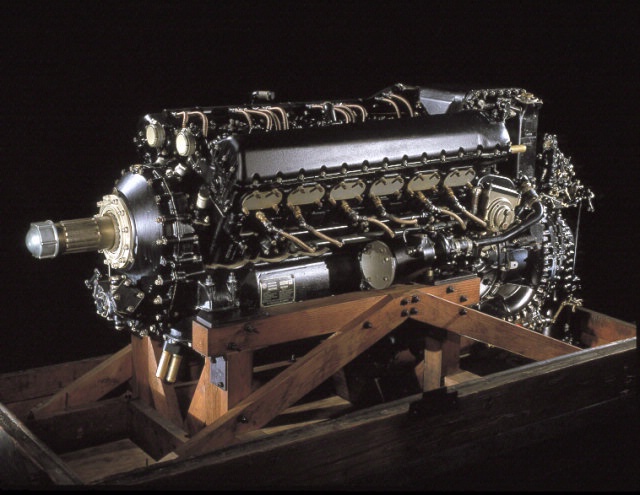
Liberty 12 Model A, V-12 Engine

Air and Space Museum

There are restrictions for re-using this image. For more information, visit the Smithsonian's Terms of Use page .
International media Interoperability Framework
IIIF provides researchers rich metadata and media viewing options for comparison of works across cultural heritage collections. Visit the IIIF page to learn more.
View manifest View in Mirador Viewer

    Object Details

    Designer

    Elbert J. Hall
    Jesse G. Vincent

    Model

    Liberty

    Physical Description

    Type: Reciprocating, 12 cylinders, V-type, Liquid-cooled
    Power rating: 298 kW (400 hp) at 1,800 rpm
    Displacement: 27.0 L (1,648.92 cu in)
    Bore and Stroke: 127 mm (5 in.) x 178 mm (7 in.)
    Weight: 383 kg (844 lb)

    Summary

    The Liberty engine was America's most important contribution to aeronautical technology during World War I. Jesse G. Vincent of Packard and Elbert J. Hall of Hall-Scott co-designed it between May 30 and June 4, 1917 for the U.S. government, which wanted a standard design in 4-, 6-, 8-, and 12-cylinder versions that could be quickly mass-produced to equip U.S. combat aircraft. To ensure a workable engine in the shortest possible time, they used only proven components, with features from both Hall-Scott and Packard. They succeeded, with the first 8-cylinder engine delivered in early July.
    However, demand for lower-power engines was already being met, and wartime experience showed the need for high power. Liberty-12s powered many aircraft types, but most were built for the de Havilland DH-4. Automakers Ford, Lincoln, Packard, Marmon, and Buick produced 20,748 Liberty 12s, with varying quality, before the Armistice, which insured their widespread use into the 1920s and '30s.

    Credit Line

    Transferred from the U.S. Navy, Naval Supply Center, Cheatham Annex, Williamsburg, Virginia

    Date

    Circa 1918

    Inventory Number

    A19731563000

    Restrictions & Rights

    Usage conditions apply

    Type

    PROPULSION-Reciprocating & Rotary

    Materials

    Steel, Aluminum, Rubber, Paint, Phonolic, Preservative coating, Brass, Copper

    Dimensions

    Height 105.4 cm (41.5 in.), Width 68.6 cm (27 in.), Depth 171.1 cm (67.375 in.)

    Country of Origin

    United States of America

    See more items in

    National Air and Space Museum Collection

    Data Source

    National Air and Space Museum

    Metadata Usage

    Not determined

    Link to Original Record

    http://n2t.net/ark:/65665/nv95f5e1985-d835-4d90-be4d-bff33e2b04dd

    Record ID

    nasm_A19731563000

    Discover More

    Image of Packard Merlin V-1650-7 engine

    Propulsion

    Image of Packard Merlin V-1650-7 engine

    Propulsion

    arrow-up Back to top
    Home
    • Facebook facebook
    • Instagram instagram
    • LinkedIn linkedin
    • YouTube youtube

    • Contact Us
    • Get Involved
    • Shop Online
    • Job Opportunities
    • Equal Opportunity
    • Inspector General
    • Records Requests
    • Accessibility
    • Host Your Event
    • Press Room
    • Privacy
    • Terms of Use