
Object Details
Designer
Charles B. King
Manufacturer
Duesenberg Motors Corporation
Designer
Ettore Bugatti
Physical Description
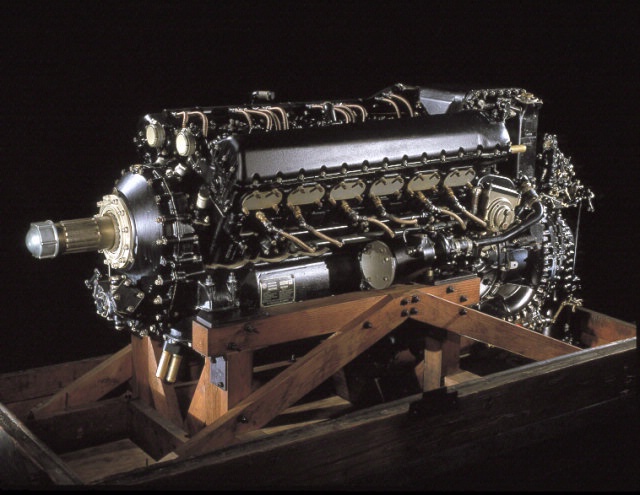
Type: Reciprocating, 16 cylinders, U-type, liquid cooled
Power rating: 306 kW (410 hp) at 2,000 rpm
Displacement: 24.3 L (1,484 cu in)
Bore and Stroke: 110 mm (4.3 in.) x 160 mm (6.3 in.)
Weight (dry): 583 kg (1,286 lb)
Summary
Ettore Bugatti designed the prototype of this engine in France during World War I. The U.S. Government's Bolling Commission, established to acquire European military aeronautical technology that could be built in America, purchased it because of its high performance potential and ability to mount a 37 mm cannon that could fire through the propeller hub. Duesenberg Motors was selected to produce the engine.
Engineer Charles B. King and his team made significant changes to correct technical problems and make the engine suitable for U.S. production methods. Renamed the King-Bugatti, it passed its 50-hour military test in October 1918. Production was just beginning when the war ended. Duesenberg manufactured about 40 King-Bugattis by early 1919. None are known to have powered a U.S. aircraft.
Credit Line
On Loan from the War Department, Air Service, Washington, D.C.
Date
1919
Inventory Number
A19200007000
Restrictions & Rights
CC0
Type
PROPULSION-Reciprocating & Rotary
Dimensions
Length 112.4 cm (44.25 in.), Width 63 cm (24.8 in.), Height 82 cm (32.28 in.) (all dimensions approximate)
Country of Origin
United States of America
See more items in
National Air and Space Museum Collection
Location
Steven F. Udvar-Hazy Center in Chantilly, VA
Hangar
Boeing Aviation Hangar
Data Source
National Air and Space Museum
Link to Original Record
Record ID
nasm_A19200007000