
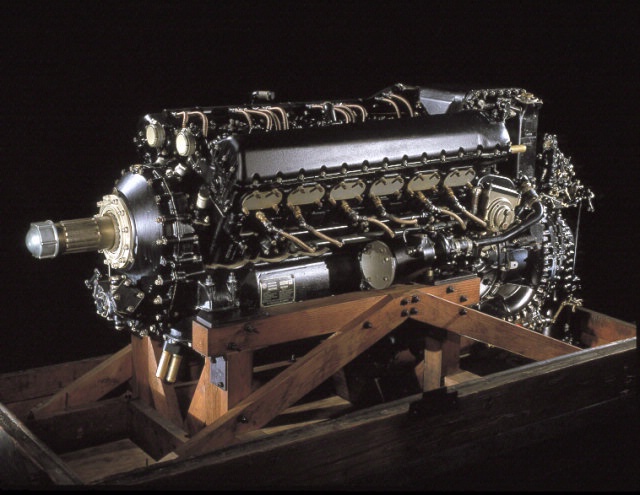
Object Details
Manufacturer
Junkers Flugzeug und Motorenwerke A.G.
Physical Description
Type: Reciprocating, in-line, 6 cylinders with 12 pistons, two cycle, liquid-cooled, Diesel, supercharger
Power rating: 746 kW (1,000 hp) at 3,000 rpm
Displacement: 16.6 L (1,526 cu in.)
Bore and Stroke: 105 mm (4.1 in.) x 2 x 160 mm (6.3 in.)
Weight: 648.6 kg (1,430 lb)
Summary
Dr. Hugo Junkers started development of his Diesel aircraft engines in a small factory at Dessau, Germany in 1911. His early engines functioned on the two-stroke cycle principle with piston-controlled parts, as did his later Junkers Jumo Diesels. Among the advantages of later, refined Diesel aircraft engines were lower specific fuel consumption (for long-range applications), lower exhaust gas temperature (for exhaust-driven supercharger installations), and reduced fire hazard as compared to conventional reciprocating aircraft engines.
The Jumo 207 was a Jumo 205 with a turbo-supercharger. A Diesel operating on a two-stroke cycle, it incorporated six cylinders and 12 opposed pistons (i.e. 2 per cylinder) in an in-line, liquid-cooled configuration. The Jumo 207 could maintain its sea-level rated power to approximately 7,900 m (26,000 ft.). The Jumo 207 A and B powered the Junkers Ju 86 P and R reconnaissance/bomber aircraft that had an absolute ceiling of approximately 15,000 m (49,000 ft.).
Credit Line
Transferred from the U.S. Navy, Naval Supply Center, Cheatham Annnex, Williamsburg, Virginia.
Date
Circa World War II
Inventory Number
A19660013000
Restrictions & Rights
CC0
Type
PROPULSION-Reciprocating & Rotary
Materials
Magnesium, Paint, Steel, Aluminum, Nickel plating
Dimensions
Height 132.6 cm (52.2 in.), Width 59.9 cm (23.6 in.), Depth 218.4 cm (86 in.)
Country of Origin
Germany
See more items in
National Air and Space Museum Collection
Data Source
National Air and Space Museum
Link to Original Record
Record ID
nasm_A19660013000