
Object Details
Manufacturer
Humber Ltd. (Coventry, England)
Designer
W. O. Bentley
Physical Description
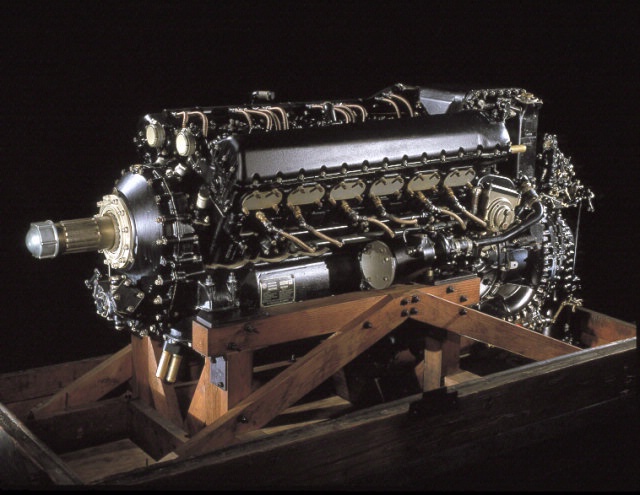
Type: Rotary, 9 cylinders, air-cooled
Power rating: 149 kW (200 hp) at 1,300 rpm
Displacement: 25.0 L (1,522.44 cu. in.)
Bore and Stroke: 140 mm (5.51 in) x 190 mm (7.09 in)
Weight (dry): Approx 227 kg (500 lb)
Summary
Initially asked in 1914 to study an overheating problem in rotary engines, Captain W. O. Bentley, an established car designer, developed a new and more efficient engine, with a weight-saving effect realized by careful design and the use of aluminum wherever possible. Equally important was the lower cost, as compared to the French Clerget, then widely used in British aircraft; and itself considered an improvement over the earlier Gnome
Following success of the smaller A.R.1 (Admiral Rotary 1), which was later renamed Model B.R.1 for Bentley Rotary 1, the larger B.R.2 rotary aircraft engine powered a variety of World War I aircraft, including, among others, the: Sopwith F.1 Camel and 7F.1 Snipe; Nieuport B.N.1; and Vickers F.B.26A Vampire II. Humber Ltd., one of five British companies that manufactured this model during World War I, built this Bentley B.R.2 artifact.
Credit Line
Gift of Preston Kirk
Date
ca. 1917
Inventory Number
A19570999000
Restrictions & Rights
CC0
Type
PROPULSION-Reciprocating & Rotary
Materials
Metal
Dimensions
3-D: 101.6 × 157.5 × 104.1cm, 336.6kg (3 ft. 4 in. × 5 ft. 2 in. × 3 ft. 5 in., 742lb.)
Support: 71 × 108 × 79cm (2 ft. 3 15/16 in. × 3 ft. 6 1/2 in. × 2 ft. 7 1/8 in.)
Country of Origin
United Kingdom
See more items in
National Air and Space Museum Collection
Location
National Air and Space Museum in Washington, DC
Exhibition
World War I: The Birth of Military Aviation
Data Source
National Air and Space Museum
Link to Original Record
Record ID
nasm_A19570999000