
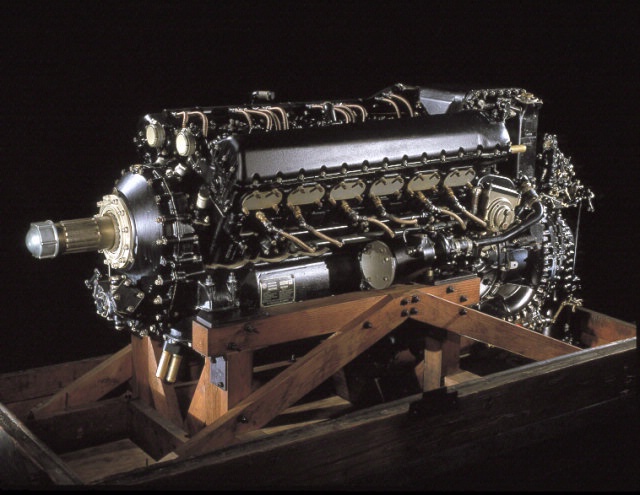
Object Details
Designer
La Société Hispano-Suiza
Manufacturer
Wright Aeronautical
Wright-Martin
Physical Description
Type: Reciprocating, 8 cylinders, V-type, Liquid-cooled
Power rating: 112 kW (150 hp) at 1,450 rpm
Displacement: 11.78 L (718.88 cu. in.)
Bore and Stroke: 120 mm (4.72 in.) x 130 mm (5.12 in.)
Weight: 312 kg (688 lb) (Approximate)
Summary
Hispano-Suiza engines were developed by Marc Birkigt, of Swiss origin, and first manufactured in Barcelona for use in automobiles. Hisso engines were very successful and featured innovative cast-aluminum cylinder construction with internal water passages. World War I, in particular, required licensing of Hisso aircraft engine manufacturing in France, England and the U.S. to meet increased aviation demand. They were all licensed under Birkigt patents which covered the number of features vital to the engine concept.
In 1916, the Wright-Martin Corporation (later Wright Aeronautical) was formed in New Brunswick, New Jersey to begin quantity production of the first Hispano-Suiza aircraft engine, the Model A, ordered by the Societe d'Exploitation des Materiels Hispano-Suiza for the Spad fighter. In the U.S., it was principally used during World War I on U.S. military training aircraft such as the Curtiss JN-4H. After the war, surplus Jennys were widely used for "barnstorming" traveling air shows-and opened the first scheduled air mail service.
Credit Line
Gift of the War Memorial Museum of Virginia
Date
Circa 1916
Inventory Number
A19721040000
Restrictions & Rights
CC0
Type
PROPULSION-Reciprocating & Rotary
Materials
Steel, Aluminum, Paint, Brass, Nickel plating, Textile, Rubber
Dimensions
Width 112.4 cm (44.25 in.), Depth 111.8 cm (44 in.), Length 157.5 cm (62 in.)
Country of Origin
United States of America
See more items in
National Air and Space Museum Collection
Location
Steven F. Udvar-Hazy Center in Chantilly, VA
Hangar
Mary Baker Engen Restoration Hangar
Data Source
National Air and Space Museum
Link to Original Record
Record ID
nasm_A19721040000