
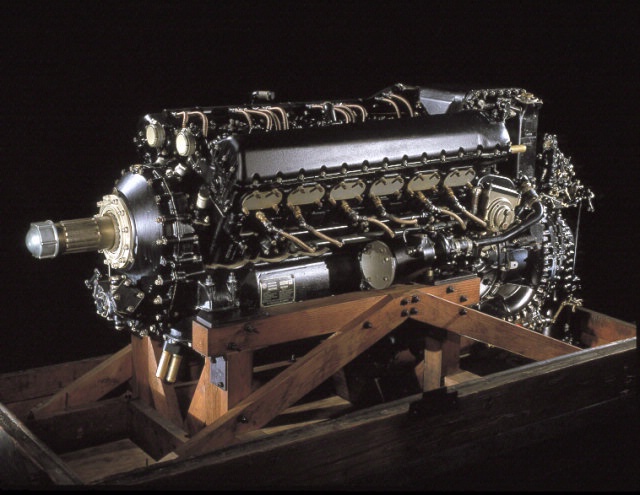
Object Details
Designer
La Société Hispano-Suiza
Manufacturer
La Société Hispano-Suiza
Physical Description
Type: Reciprocating, 12 cylinders, V-type, Fuel injected, Supercharged, Liquid-cooled
Power rating: 641 kW (860 hp) at 2,400 rpm
Displacement: 36 L (2,196 cu in.)
Bore and Stroke: 150 mm (5.9 in.) x 170 mm (6.7 in.)
Weight: 459.9 kg (1,014 lb)
Summary
Marc Birkigt, an inventor of Swiss origin, developed Hispano-Suiza (meaning Spanish-Swiss) engines, and first manufactured them in Barcelona for use in automobiles. Hisso engines were very successful and, to save weight, featured innovative cast-aluminum cylinder construction with internal water passages and screwed-in steel sleeves. Particularly to meet demand in World War I required licensing of Hisso aircraft engine manufacturing in France, England and the U.S by Wright-Martin, later the Wright Aeronautical Corporation.
Hispano-Suiza introduced its 12Y series of engines in 1932. The 12 cylinders were arranged in a V at 60 degrees and all models had propeller reduction gears with provision to fire a cannon through the hub, with the cannon mounted on the V. Centrifugal superchargers mounted at the rear of the engine delivered air to six carburetors, with three attached to the outside of each block. This type of engine powered the Latecoere 298, Morane-Saulnier 406, and Arsenal VG-31 and VG-33.
Credit Line
Transferred from the U.S. Navy
Date
Circa 1932
Inventory Number
A19710900000
Restrictions & Rights
CC0
Type
PROPULSION-Reciprocating & Rotary
Materials
Aluminum, Steel, Paint, Rubber, Phenolic, Wood, Textile
Dimensions
Height 76.5 cm (30.1 in.), Width 93.5 cm (36.8 in.), 172.2 cm (67.8 in.)
Country of Origin
France
See more items in
National Air and Space Museum Collection
Data Source
National Air and Space Museum
Link to Original Record
Record ID
nasm_A19710900000