
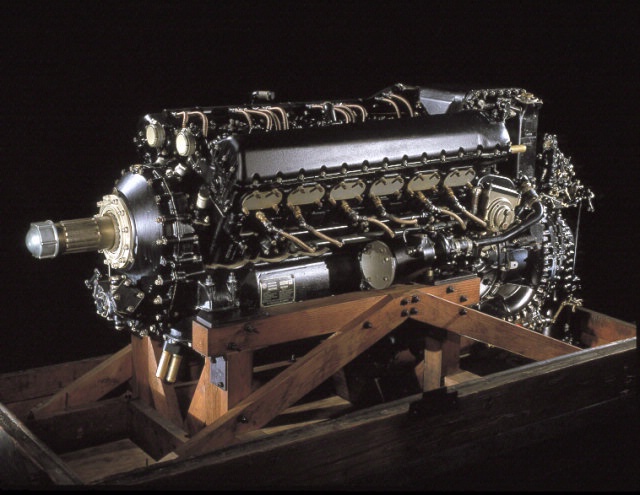
Object Details
Manufacturer
Hirth-Motoren G.m.b.H.
Physical Description
Type: Reciprocating, 4 cylinders, In-line, Inverted, Air cooled
Power rating: 78.3 kW (105 hp) at 2,530 rpm
Displacement: 3.98 L (243 cu in.)
Bore and Stroke: 105 mm (4.128 in.) x 115 mm (4.52 in.)
Weight: 123.8 kg (273 lb)
Summary
Hellmuth Hirth was a famous pre-World War I aviator and an excellent engineer. With his brother, Dr. Albert Hirth, he developed an improved engine using roller bearings. Albert patented the Hirth coupling still used in many gas turbines. Hirth-Motoren G.m.b.H. of Stuttgart, Germany, was organized in 1931 following the successful performance of the HM 60 in several air races. The HM-60 was a 48.5 kW (65 shp) air-cooled, inverted direct-drive four-cylinder engine first run in 1923.
During 1935-45, following the development of various engine designs, Hirth introduced its 4-, 6-, and 8-cylinder HM 504, HM 506, and HM 508 series. All inverted air-cooled designs, they were respectively rated at 78.3, 119, and 209 kW (105, 160, and 280 shp). The most successful of these was the HM 504 which powered the Bucker Bu 131 B, Klemm Kl 35B, and Arado-Kabinenzweisitzers Ar 79. Today Hirth 2 cycle engines power ultralight and other light planes.
Credit Line
Transferred from the U.S. Air Force Museum
Date
Circa 1943
Inventory Number
A19670102000
Restrictions & Rights
Usage conditions apply
Type
PROPULSION-Reciprocating & Rotary
Materials
Aluminum
Steel
Paper
Adhesive
Paint
Rubber
Dimensions
Depth 95.7 cm (37.7 in.), Width 50.5 cm (19.9 in.), Height 72.7 cm (28.6 in.)
Country of Origin
Germany
See more items in
National Air and Space Museum Collection
Data Source
National Air and Space Museum
Link to Original Record
Record ID
nasm_A19670102000