
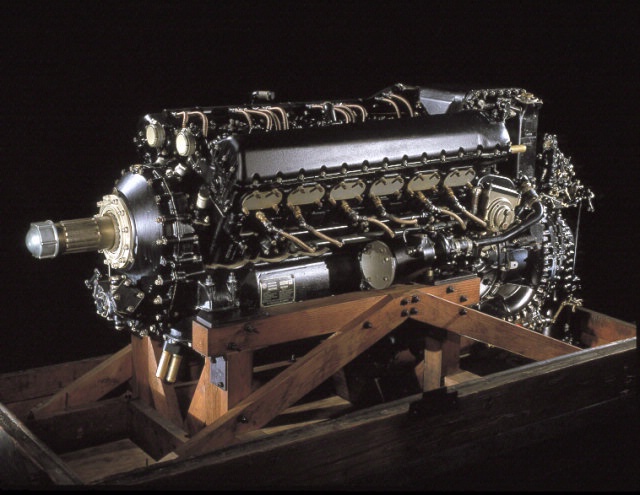
Object Details
Designer
Laurent Seguin
Louis Seguin
Manufacturer
Societe des Moteurs Gnome et Rhône
Physical Description
Type: Rotary, 9 cylinders, air-cooled, monosoupape
Power rating: 123 kw (165 hp) at 1,350 rpm
Displacement: 15.9 L (970.38 cu. in.)
Bore and Stroke: 115 mm (4.53 in.) x 170 mm (6.69 in.)
Weight: 132 kg (290 lb)
Summary
The rotary engine reduced rough the running and overheating of early air-cooled engines, namely. Disadvantages were gyroscopic forces, lubrication losses, low time-between-overhaul, air resistance to rotating cylinders, and limited rpm.
The first successful rotary engine is generally attributed to the American F.O. Farwell in 1896; but the French Gnome engine, developed by the Seguin brothers, was much more successful in bringing the rotary to a broad aviation market beginning in 1909. The original Gnome had two valves, with the inlet in the head of the piston and the exhaust in the in the cylinder head. The monosoupape, as the name signifies, had only one valve in the cylinder head, eliminating a weak feature of the earlier design, and was the most numerous model during World War I.
It powered the French Nieuport, Bleriot, and Pomier aircraft, the British Nieuport 28C.1 and Sopwith F.1 Camel, and was also built under license in England, Italy, and the U.S.
Credit Line
Gift of the University of Connecticut
Date
Circa World War I
Inventory Number
A19750202000
Restrictions & Rights
Usage conditions apply
Type
PROPULSION-Reciprocating & Rotary
Dimensions
Diameter 102 cm (40 in.), Length 109 cm (43 in.)
Country of Origin
France
See more items in
National Air and Space Museum Collection
Data Source
National Air and Space Museum
Link to Original Record
Record ID
nasm_A19750202000