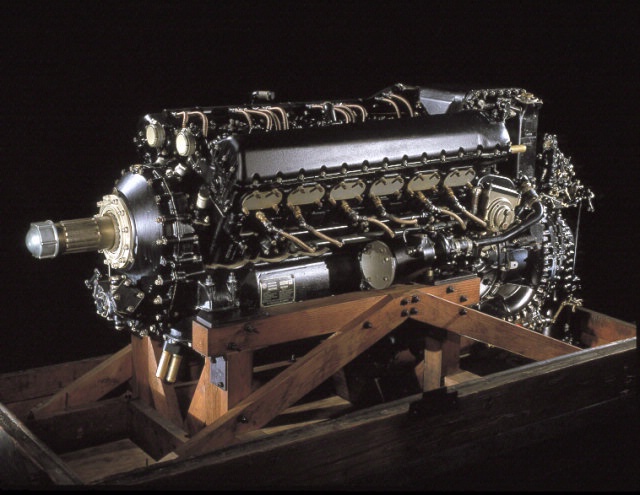
Object Details
Designer
Laurent Seguin
Louis Seguin
Manufacturer
Societe des Moteurs Gnome et Rhône
Physical Description
Type: Rotary, 7 cylinders, air-cooled
Power rating: 37.3 KW (50 hp) at 1,200 rpm
Displacement: 8.01 L (488.5 cu in)
Bore and Stroke: 110 mm (4.33 in) x 120 mm (4.73 in)
Weight: 75.6 kg (166.5 lb)
Summary
Although numerous rotary aircraft engines were made by many manufacturers, the French Gnome, developed by the Seguin brothers, was most successful in bringing the rotary to a broad aviation market. More than 20,000 Gnomes of different models were made by the end of World War I.
This artifact was first installed on a hydroplane which made an unsuccessful attempt to fly from the Seine River. Henry Farman installed the engine in his biplane which first flew in April 1909. In August 1909, at the first aviation meet in Reims, that aircraft won the Grand Prix with records of distance and duration. The engine was later installed in L. Paulhan's aircraft and set another distance record. The first successful seaplane flight was made by Henri Fabre in March 1910, in an aircraft powered by another Gnome Omega engine.
The artifact was given to the donor by Amedee Seguin, son of Louis Seguin, co-inventor of the engine.
Credit Line
Gift of Rear Admiral Lauren S. McCready, USMS
Date
1908
Inventory Number
A19990069000
Restrictions & Rights
Usage conditions apply
Type
PROPULSION-Reciprocating & Rotary
Materials
Nickel Steel Overall
Dimensions
3-D: 76.2 × 83.8cm, 78kg (30 × 33 in., 172lb.)
Support: 185.4 × 73.7 × 73.7cm (73 × 29 × 29 in.)
Country of Origin
France
See more items in
National Air and Space Museum Collection
Location
National Air and Space Museum in Washington, DC
Exhibition
Early Flight
Data Source
National Air and Space Museum
Link to Original Record
Record ID
nasm_A19990069000