
Object Details
Designer
Laurent Seguin
Louis Seguin
Manufacturer
Societe des Moteurs Gnome et Rhône
Physical Description
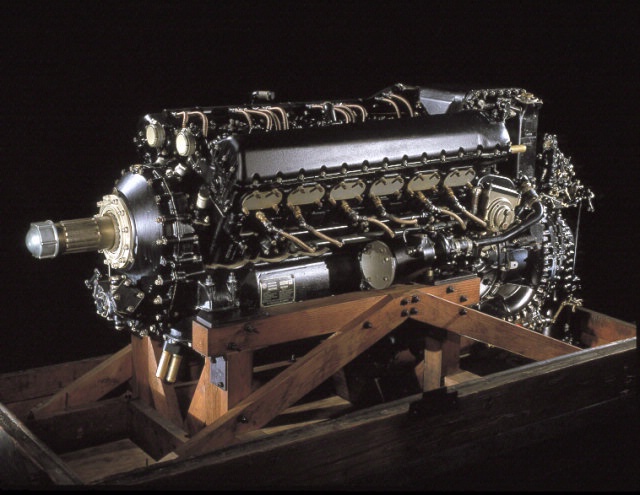
Detached engine components, with 1 cardboard box filled with rings, gaskets, and hardware.
Type: Rotary, monosoupape (single valve), 9 cylinders, air-cooled
Power rating: 75 kW (100 hp) at 1,200 rpm
Displacement: 12.8 L (783.27 cu in..)
Bore and Stroke: 110 mm (4.33 in.) x 150 mm (5.91 in.)
Weight: 123 kg (272 lb)
Summary
The first successful rotary engine is generally attributed to the American F.O. Farwell in 1896; but the French Gnome engine, developed by the Seguin brothers, was much more successful in bringing the rotary to a broad aviation market beginning in 1909. The original Gnome engines had two valves, with the inlet in the head of the piston and the exhaust in the in the cylinder head. The monosoupape, as the name signifies, had only one valve in the cylinder head, which eliminated a weak design feature of the earlier design, and was the most numerous model during World War I.
This engine was also manufactured in England, Italy, and the U.S., and used on aircraft types including the: Nieuport 12 and 28; Royal Aircraft Factory B.E.8 and F.E.8; Sopwith Pup and F.1 Camel; Vickers F.B.5 and 6 Gunbus; Airco D.H.2 and D.H.5; Avro 504 E/J/K/M; and Bristol 4 Scout D and 8 Scout S.2A.
Credit Line
Gift of Don Coe
Date
1917
Inventory Number
A19490063000
Restrictions & Rights
Usage conditions apply
Type
PROPULSION-Reciprocating & Rotary
Materials
Ferrous Alloys (Steel)
Copper Alloy
Aluminum Alloy
Phenolic Resin
Dimensions
3-D (Central Hub, Largest Piece, Diameter x Height): 52.1 × 26cm (1 ft. 8 1/2 in. × 10 1/4 in.)
3-D (Each Cylinder, Diameter x Length): 14.6 × 32.7cm (5 3/4 in. × 1 ft. 7/8 in.)
Storage (Wood Storage Crate): 102.9 × 52.1 × 37.5cm, 171.9kg (3 ft. 4 1/2 in. × 1 ft. 8 1/2 in. × 1 ft. 2 3/4 in., 379lb.)
Country of Origin
France
See more items in
National Air and Space Museum Collection
Data Source
National Air and Space Museum
Link to Original Record
Record ID
nasm_A19490063000