
Object Details
Manufacturer
General Electric Aircraft Engines
Physical Description
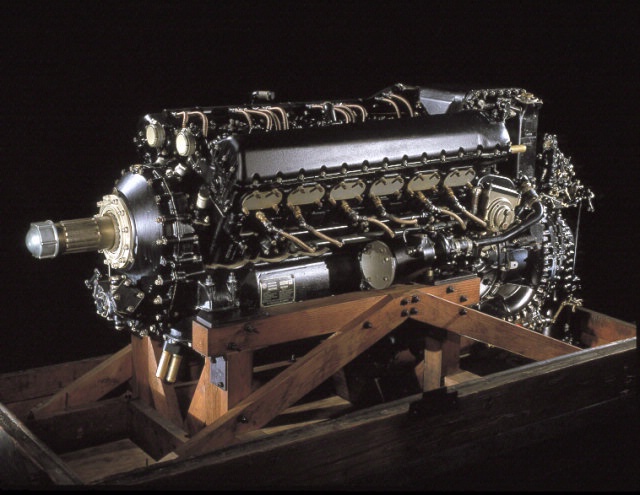
Powered cutaway model of a General Electric T31 (TG-100) Turboprop engine.
Type: Turboprop
Power: 1,551 kw (2,080 eshp) at 13,000 rpm
Compressor: 14-stage axial
Combustor: 9 chambers
Turbine: Single-stage axial
Weight: 900 kg (1,984 lb)
Summary
The GE TG-100 (military designation T31) was the outgrowth of a National Advisory Committee for Aeronautics project initiated in 1941 by General Henry H. Arnold, Chief of the Army Air Corps. Designed at the Steam Turbine Division in Schenectady, N.Y., it was first ground tested in 1943 without a propeller.
In late-1945, the TG-100, in a Consolidated Vultee XP-81, became the first turboprop to be flown in the U.S., and made more than 100 flights in the XP-81 and Ryan XF2R-1. Although originally designed for 895 kw (1,200 shp), the TG-100 delivered 1,268 kw (1,700 shp) in early tests, and was later rated at 1,641 kw (2,200 shp). In 1949, the TG-100 project was canceled as a result of increased interest in the development of jet engines.
The TG-100 was the first GE aircraft engine to use an axial-flow compressor. Knowledge gained from it contributed to the development of the GE axial-flow turbine engines that followed.
Credit Line
Transferred from the U.S. Naval Academy, Department of the Navy
Date
Circa 1945
Inventory Number
A19630094000
Restrictions & Rights
Usage conditions apply
Type
PROPULSION-Turbines (Jet)
Materials
HAZ MAT: Cadmium (Possible)
Aluminum Alloys
Ferrous Alloys
Rubber
Paints
Copper Alloys
Electronic Components
Adhesive Tape
Resin
Glazed Ceramic
Display Case: Wood and Plywood
Paints
Plastics
Electronic Components
Adhesives
Aluminum Alloy
Ferrous Alloy
Varnish
Velcro
Dimensions
3-D (Display Case, Overall): 314.6 × 118.4 × 157.5cm (10 ft. 3 7/8 in. × 3 ft. 10 5/8 in. × 5 ft. 2 in.)
Other (Dimensions from TG-100B/T31-GE-3, Diameter x Length): 2 ft. 11 1/8 in. × 9 ft. 6 5/8 in. (89.2 × 291.1cm)
Overall: 1984lb. (899.9kg)
Country of Origin
United States of America
See more items in
National Air and Space Museum Collection
Data Source
National Air and Space Museum
Link to Original Record
Record ID
nasm_A19630094000