
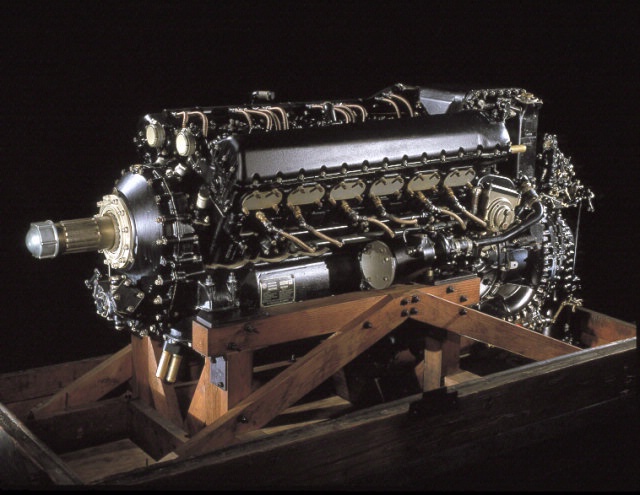
Object Details
Manufacturer
General Electric Aircraft Engines
Physical Description
Type: Turbojet, with afterburner
Thrust: 33,360 N (7,500 lb) at 7,950 rpm
Compressor: 12-stage axial
Combustor: 8 chambers
Turbine: Single-stage axial
Weight: 1,361 kg (3,000 lb)
Summary
In 1946, GE proposed to the Army Air Forces a new engine, more powerful and fuel efficient than its earlier J35, but within the same frame size. To provide higher pressure ratios, and overall better performance, GE chose an axial-flow compressor design. First tested in 1947, the J47 passed its 150-hour test in 1948, and went into production later in the same year. Production ended in 1956, with more than 35,000 J47s manufactured, making it the most mass-produced turbojet engine in history.
The J47 powered a wide variety of aircraft including the the North American B-45 Tornado bomber, Consolidated-Vultee B-36 bomber (boost power), Boeing B-47 Stratojet bomber, Martin XB-51 attack bomber, North American F-86 Sabre Jet fighter, North American FJ-2 Fury fighter, Republic XF-91 interceptor, Chase XC-123A transport, and Boeing KC-97 Stratotanker (boost power). This J47-GE-17 engine powered the North American F-86D Sabre Jet and the Italian Fiat F-86K.
Credit Line
Transferred from the U.S. Air Force Museum, Wright-Patterson AFB, Ohio
Date
Circa 1954
Inventory Number
A19600242000
Restrictions & Rights
Usage conditions apply
Type
PROPULSION-Turbines (Jet)
Dimensions
Length 574 cm (226.0 in.), Diameter 93 cm (36.75 in.)
Country of Origin
United States of America
See more items in
National Air and Space Museum Collection
Data Source
National Air and Space Museum
Link to Original Record
Record ID
nasm_A19600242000