
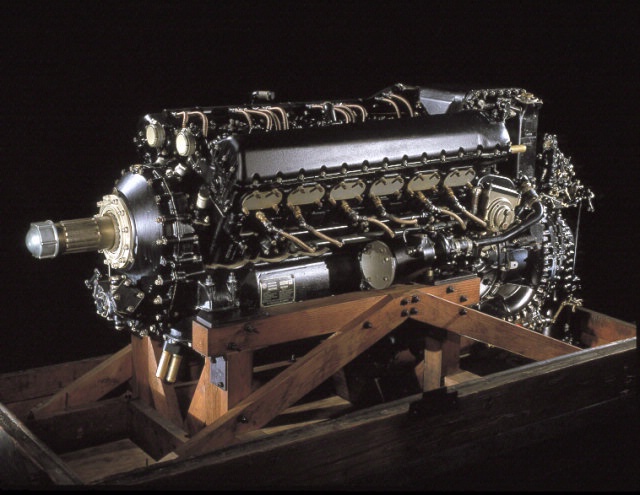
Object Details
Manufacturer
General Electric Aircraft Engines
Physical Description
Type: Turbojet
Thrust: 7,161 N (1,610 lb) at 16,500 rpm
Compressor: Single-stage centrifugal
Combustor: 10 reverse-flow combustion chambers
Turbine: Single-stage axial
Weight: 386 kg (850 lb)
Summary
Through a representative in England, General Electric learned of the pioneering jet engine development of Frank Whittle. This resulted in a visit by General H.H. Arnold, Chief of the U.S. Army Air Corps, and manufacture of the Whittle engine by GE. The American engine incorporated a number of mechanical improvements, and two I-A engines first flew in a Bell P-59A in 1942.
GE followed with two designs of increased thrust; first the I-14 (aimed at 6,227 N (1,400 lb.) thrust) and then with the I-16. The J31-GE-4 or -5 (I-16-4 or-5) models provided continuing improvements such as improved turbine cooling intended for the P-59 aircraft.
Believing future tactical needs would require turbojets to use the same fuel as reciprocating engines, the U.S. Navy developed a 100-octane, gasoline-burning version of the standard I-16, which normally ran on kerosene fuel. The Navy’s first application of jet propulsion was the Ryan FR Fireball, a mixed-power (piston and jet-powered) fighter aircraft.
Credit Line
Found in the collection
Date
Circa World War II
Inventory Number
A19660042000
Restrictions & Rights
Usage conditions apply
Type
PROPULSION-Turbines (Jet)
Materials
Aluminum
Paint
Steel
Rubber
Adhesive
Paper
Cadmium Plating
Dimensions
Approximate: 185.4 × 124.5 × 99.1cm (73 × 49 × 39 in.)
3-D (Current Storage): 120.7 × 127 × 201.9cm (47 1/2 × 50 × 79 1/2 in.)
Storage: 215.9 × 154.9 × 129.5cm (85 × 61 × 51 in.)
Overall: 850lb. (385.6kg)
Other: 72 x 41 1/2in. (182.9 x 105.4cm)
Country of Origin
United States of America
See more items in
National Air and Space Museum Collection
Data Source
National Air and Space Museum
Link to Original Record
Record ID
nasm_A19660042000