
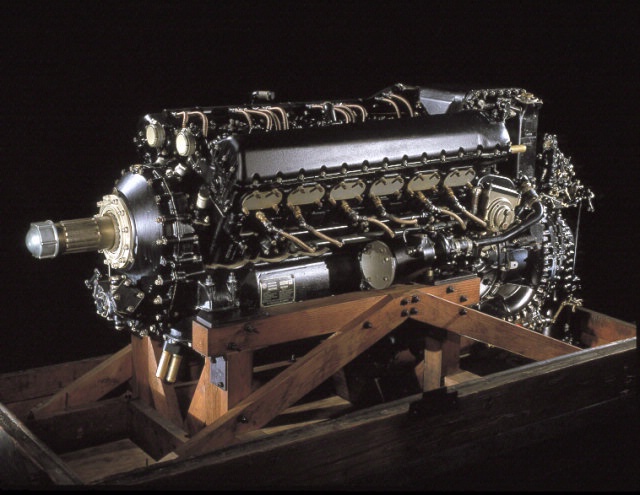
Object Details
Manufacturer
Wright Aeronautical
Physical Description
Type: Reciprocating, 9 cylinders, radial, air cooled
Power rating: 746 kW (1,000 hp) at 2,300 rpm
Displacement: 29.9 L (1,823 cu in.)
Bore and Stroke: 156 mm (6.125 in.) x 175 mm (6.875 in.)
Weight: 593.3 kg (1,308 lb)
Summary
The Cyclone engine series began in 1924 when the U.S. Navy Department contracted with the Wright Aeronautical Corporation for a nine-cylinder air-cooled radial engine of approximately the same displacement as the water-cooled Liberty engine of World War I. The first engine, known as the P-1, had a rating of 303 kW (406 hp), and gained favor among aircraft builders because of its fuel economy, long service life, easy and economical maintenance, and low weight/horsepower ratio. Through progressive improvements, the rating of later models was raised to an impressive 895 kW (1,200 shp) for takeoff.
Air-cooled radial engines became the standard for naval aircraft, and appealed to designers of commercial transports. With few exceptions, commercial aircraft relied on air-cooled radial engines until the advent of jet engines.
A total of 118 of the -73 models were manufactured between October 1940 and March 1941, and powered the World War II Boeing B-17C bomber.
Credit Line
Transferred from the U.S. Air Force Central Museum
Date
Circa 1940
Inventory Number
A19600114000
Restrictions & Rights
Usage conditions apply
Type
PROPULSION-Reciprocating & Rotary
Materials
Aluminum
Steel
Rubber
Paint
Copper Alloy
Wood
Ceramic
Magnesium Alloy
Plastic
Synthetic fabric
Dimensions
Diameter 140 cm (55.1 in.), Length 122.9 cm (48.4 in.)
Country of Origin
United States of America
See more items in
National Air and Space Museum Collection
Data Source
National Air and Space Museum
Link to Original Record
Record ID
nasm_A19600114000