
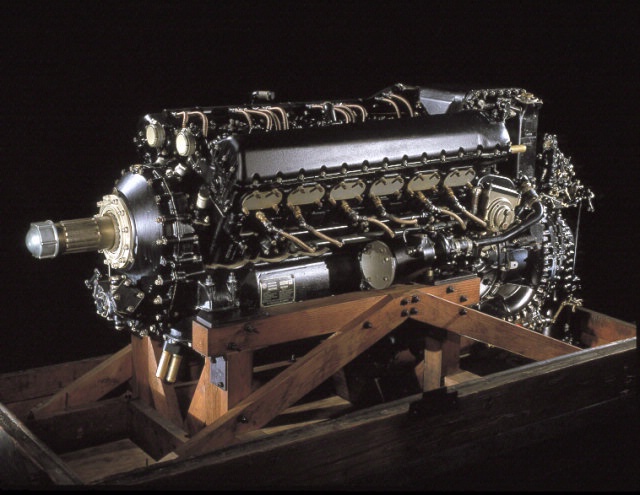
Object Details
Manufacturer
Wright Aeronautical
Physical Description
Type: Reciprocating, 9 cylinders, single-row, radial, air-cooled
Power rating: 671 kW (900 hp) at 2,300 rpm
Displacement: 29.88 L (1,823 cu in.)
Bore and Stroke: 156 mm (6.125 in.) x 174 mm (6.875 in.)
Weight: 584 kg (1,287 lb)
Summary
The Wright Cyclone series began in 1924 with a U.S. Navy contract for a nine-cylinder air-cooled radial engine having approximately the same displacement as the water-cooled World War I era Liberty engine. By 1930 the Cyclone displacement had grown considerably, and the R-1820 played a major role in establishing scheduled airline operation in the U.S. and abroad, particularly with the highly successful Douglas DC-3.
With a gearbox between the engine and propeller, the GR-1820 allowed the propeller to rotate at a slower, more efficient speed than possible with a direct drive. In 1936, the Cyclone G series, rated at 746 kW (1,000 hp), was introduced.
Besides the DC-3, the Wright Cyclone GR-1820-G102 through -G109 series powered a number of aircraft, including the: Boeing 307/B, Brewster 339E/B (F2A), Curtiss-Wright 75Q/H/AH, Dornier DO24K2/DO24, Douglas DC-5, Lockheed C-56, Lockheed 14/14M2/B-14L/414-40/214-40, Lockheed 18, Lockheed XR50-1/R-50-1/R50-3, Martin 139WH, NAA O47B, Republic 2PA-BX, and Vultee V-12-C.
Credit Line
Gift of Wright Aeronautical Corporation
Date
Circa 1938
Inventory Number
A19490007000
Restrictions & Rights
Usage conditions apply
Type
PROPULSION-Reciprocating & Rotary
Materials
HAZMAT: Cadmium Plating, Magnesium Alloy
Aluminum
Steel
Stainless Steel
Leather
Anodized Aluminum
Copper Alloy
Rubber
Cotton Thread
Paint
Dimensions
Length 182.9 cm (72 in.), Width 134.6 cm (53 in.), Height 144.8 cm (57 in.)
Country of Origin
United States of America
See more items in
National Air and Space Museum Collection
Data Source
National Air and Space Museum
Link to Original Record
Record ID
nasm_A19490007000