
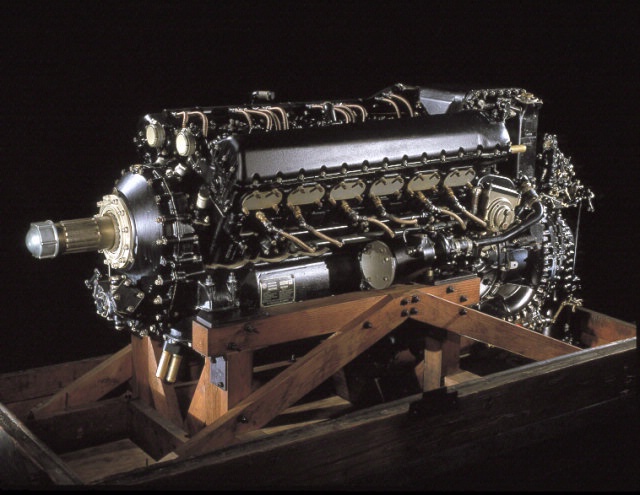
Object Details
Manufacturer
Aviation Gas Turbine Div., Westinghouse Electric Corp., Philadelphia, PA
Physical Description
Type: Turbojet
Thrust: 13,344 N (3,000 lb)
Compressor: 11-stage axial
Combustor: Double annular combustion chamber
Turbine: 2-stage axial
Weight: 558 kg (1,230 lb)
Summary
In response to the 1941 Special Committee on Jet Propulsion of the National Advisory Committee for Aeronautics, the Westinghouse proposed development of a turbojet engine, but started development without a contract.
Development of the third in the Westinghouse turbojet series, the X24C, began in 1944. Designed to weigh 454 kg (1,000 lb.) and develop a static thrust of 13,344 N (3,000 lb.), it was intended to be better for use in a two-engine fighter than Westinghouse's earlier X19B turbojet. The Navy Bureau of Aeronautics ordered two X24C units plus spares in 1945, and, by 1946, four models were under development, including the X24C-2/-4A/-4B/-6.
Approximately 5,000 Westinghouse 24C (military designation J34) engines were built. These powered the Chance Vought F6U-1 Pirate, Chance Vought XF7U-1 and F7U-1/-2 Cutlass, McDonnell F2H-1 Banshee, and Douglas XF3D-1 Skyknight. This J34-WE-22A artifact powered the first flight of the Chance Vought XF6U in 1946, McDonnell prototype F2H in 1947, and the Douglas XF3D-1 in 1948.
Credit Line
Transferred from the U.S. Navy, NSD, Mechanicsburg, Pennsylvania
Date
Post World War II
Inventory Number
A19670026000
Restrictions & Rights
Usage conditions apply
Type
PROPULSION-Turbines (Jet)
Materials
HAZMAT: Cadmium Plating, Magnesium
Aluminum, Preservative coating, Steel, Rubber
Dimensions
Length 304.8 cm (120 in.), Diameter 61 cm (24 in.)
Country of Origin
United States of America
See more items in
National Air and Space Museum Collection
Data Source
National Air and Space Museum
Link to Original Record
Record ID
nasm_A19670026000