
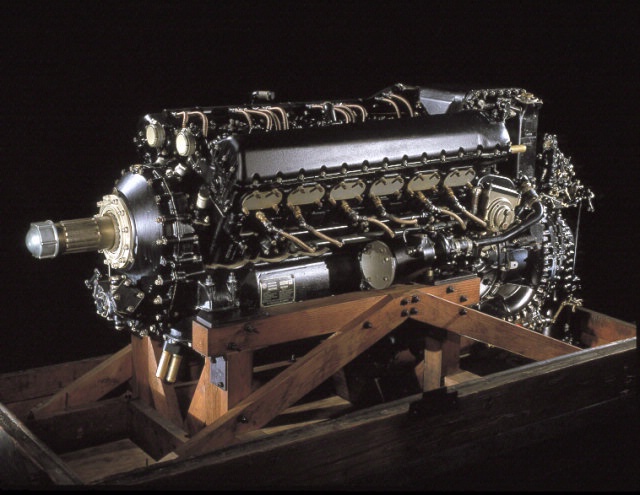
Object Details
Manufacturer
Lycoming (Williamsport, Pennsylvania)
Physical Description
Type: Reciprocating, H-type, 24 cylinders, water-cooled
Power rating: 1,715 kW (2,300 hp) at 3,000 rpm
Displacement: 40 L (2,468 cu in.)
Bore and Stroke: 133 mm (5.3 in.) x 121 mm (4.8 in.)
Weight: 1,088.6 kg (2,400 lb)
Summary
By 1939, the U.S. Air Corps Research Board decided among the needs in the liquid-cooled field were 1,342 to 1,491 kW (1,800 to 2,000 hp) flat engines for installation in bomber wings; requirements only attainable by an H type.
Lycoming had already begun studies for a 24-cylinder H-2470 engine, just two O-1230 opposed engines pancaked together. The first H-2470 is believed to have passed a development test in 1942, and the Navy sent a letter of intent ordering 100 engines, for which the principal use was to be the Curtiss F14C fighter, the first carrier fighter designed with a liquid-cooled engine since 1925. However, before the new factory went into production, the Navy decided that it would be available in quantity too late to be of use in the war, and accordingly canceled its contract.
This XH-2470-1 engine was flight tested in the Army Vultee XP-54in 1943, but not produced for similar reasons.
Credit Line
Transferred from the U.S. Air Force Central Museum
Date
Circa 1941
Inventory Number
A19600102000
Restrictions & Rights
Usage conditions apply
Type
PROPULSION-Reciprocating & Rotary
Materials
HAZMAT: Cadmium
Non-magnetic white metal
Ferrous alloy
Unknown coating
Paint
Grease
Wood
Synthetic Fabric
Adhesive sticker
Tape
Glass
Silica gel
Copper
Dimensions
3-D: 228.6 × 82.5 × 128.3cm, 1088.6kg (7 ft. 6 in. × 2 ft. 8 1/2 in. × 4 ft. 2 1/2 in., 2400lb.)
Country of Origin
United States of America
See more items in
National Air and Space Museum Collection
Data Source
National Air and Space Museum
Link to Original Record
Record ID
nasm_A19600102000