
Object Details
Manufacturer
Air Technical Arsenal, Japan
Designer
Hirth-Motoren G.m.b.H.
Hitachi
Physical Description
Type: Reciprocating, 4 cylinders, In line, Air cooled
Power rating: 67 kW (90 hp) at 2,320 rpm
Displacement: 3.97 L (242.44 cu in.)
Bore and Stroke: 105 mm (4.13 in.) x 115 mm (4.53 in.)
Weight: 110 kg (242.5 lb)
Summary
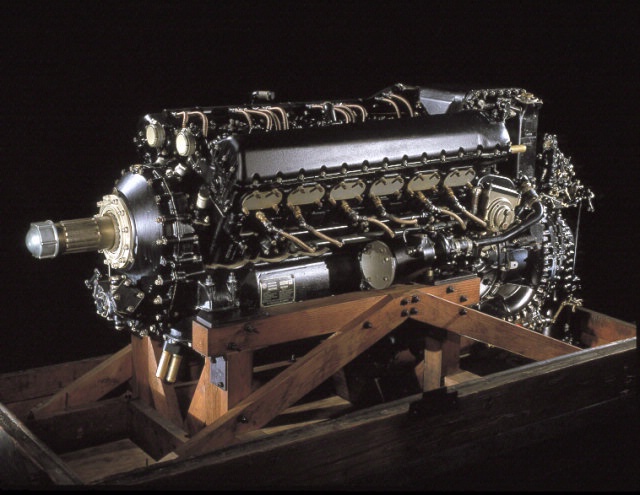
This artifact is a reconfigured version of a license built Hirth 504a engine, which was named the Hitachi Hatzukaze 11. With step up gearing in the nose, it became the Hitachi Hatzukaze 13. This engine type is believed to have been utilized by Japan in the World War II Ohka 22 flying bomb as the reciprocating component of a Campini-type jet engine.
Hellmuth Hirth was a famous pre-World War I aviator and an excellent engineer. Hirth-Motoren G.m.b.H. of Stuttgart, Germany, was organized in 1931. During 1935-45, following the development of various engine designs, Hirth introduced its 4-, 6-, and 8-cylinder HM 504, HM 506, and HM 508 series, all inverted air-cooled designs. The most successful of these was the HM 504 which powered the Bucker Bu 131 B, Klemm Kl 35B, and Arado-Kabinenzweisitzers Ar 79. Today Hirth 2 cycle engines power ultralight and other light planes.
Credit Line
Transferred from the U.S. Air Force Museum
Date
Circa World War II
Inventory Number
A19670115000
Restrictions & Rights
Usage conditions apply
Type
PROPULSION-Reciprocating & Rotary
Materials
Ferrous Alloy
Non-Magnetic Metals
Unknown Coating
Fabric Tape
Plastic
Paint
Dimensions
3-D (Object on stand): 147.3 × 87.6 × 104.1cm (4 ft. 10 in. × 2 ft. 10 1/2 in. × 3 ft. 5 in.)
Country of Origin
Japan
See more items in
National Air and Space Museum Collection
Data Source
National Air and Space Museum
Link to Original Record
Record ID
nasm_A19670115000