
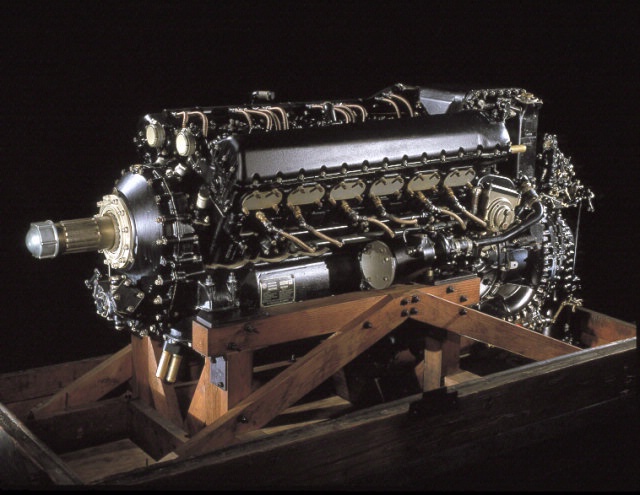
Object Details
Manufacturer
Heinkel-Hirth (Hirth-Motorenwerke), Stuttgart, Germany
Physical Description
Type: Turbojet
Thrust: 12,721 N (2,860 lb) at 9,000 rpm
Compressor: Single mixed flow, 3 axial
Combustor: Annular
Turbine: 2-stage axial
Weight: 948 kg (2,090 lb)
Summary
In the fall of 1942, Heinkel received a contract for the He S 011, a high pressure ratio engine with a growth potential of 15,568 N (3,500 lb.). Dr. Hans von Ohain, who generally shares credit with Britain’s Sir Frank Whittle for independently inventing the jet engine, designed the engine
Some advanced features included a novel high mass flow, high pressure ratio inducer stage followed by a 3-stage, 50 percent reaction axial compressor, and a two-stage, air-cooled, axial-flow turbine. The first engine ran in early 1944, and by early 1945 it met or exceeded all of the performance goals. The engine was flight tested under the fuselage of a Junkers Ju-88 test-bed aircraft, but was not ready for production before the war ended in Europe and only small numbers of prototypes were produced. Its one intended airframe application, the Heinkel He 162a, was also not built.
Credit Line
Found in collection
Date
Circa World War II
Inventory Number
A19670025000
Restrictions & Rights
Usage conditions apply
Type
PROPULSION-Turbines (Jet)
Materials
Steel
Aluminum
Copper Alloy
Plastic
Rubber
Natural Fabric
Paint
Phenolic Resin
Dimensions
Length 351 cm (138.2 in.), Diameter 87.4 cm (34.4 in.)
Country of Origin
Germany
See more items in
National Air and Space Museum Collection
Data Source
National Air and Space Museum
Link to Original Record
Record ID
nasm_A19670025000