
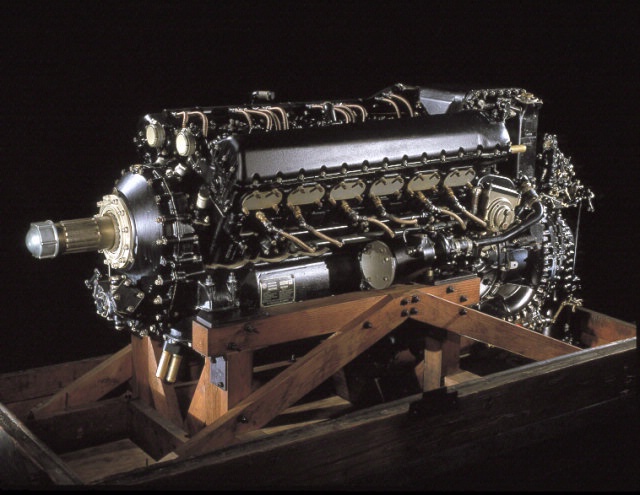
Object Details
Manufacturer
Guiberson Diesel Engine Company (Dallas, Texas)
Physical Description
Type: Reciprocating, 9 cylinders, radial, air-cooled
Power rating: 179 kW (240 hp) at 2,020 rpm
Displacement: 15.0 L (918 cu in.)
Bore and Stroke: 120.7 mm (4.75 in.) x 146.1 mm (5.75 in.)
Weight: 675 kg (550 lb)
Summary
In April 1931, the Guiberson Diesel Engine Company of Dallas, Texas, displayed publicly for the first time its A-980 Diesel aircraft engine, based on designs of F.A. Thaheld. The 9-cylinder, air-cooled radial was rated at 138 kW (185 shp), test flown in a Waco biplane, and certificated in November 1931. In 1934, the U.S. Navy , interested in Diesel engines for their low specific fuel consumption, ordered the slightly larger A-918 diesel, and two were delivered to the Bureau of Aeronautics for testing where they were rated at 189 kW (253 shp).
In June 1936, the U.S. Navy ordered two more of the improved XR-918-2 engines, which successfully completed a 50-hour development test run at the Naval Aircraft Factory. However, Diesels proved too heavy for their power rating, and weren't used as combat engines. Savings in specific fuel consumption were offset by the increased fuel load required to compensate for the increased power plant weight.
Credit Line
Transferred from the U.S. Navy
Date
Circa 1936
Inventory Number
A19710889000
Restrictions & Rights
Usage conditions apply
Type
PROPULSION-Reciprocating & Rotary
Materials
Steel
Aluminum
Magnesium Alloy
Rubber
Plastic
Copper Alloy
Rubberized Fabric
Cadmium Plating
Paint
Dimensions
Diameter 118.7 cm (46.75 in.), Length 90.5 cm (35.625 in.)
Country of Origin
United States of America
See more items in
National Air and Space Museum Collection
Data Source
National Air and Space Museum
Link to Original Record
Record ID
nasm_A19710889000