
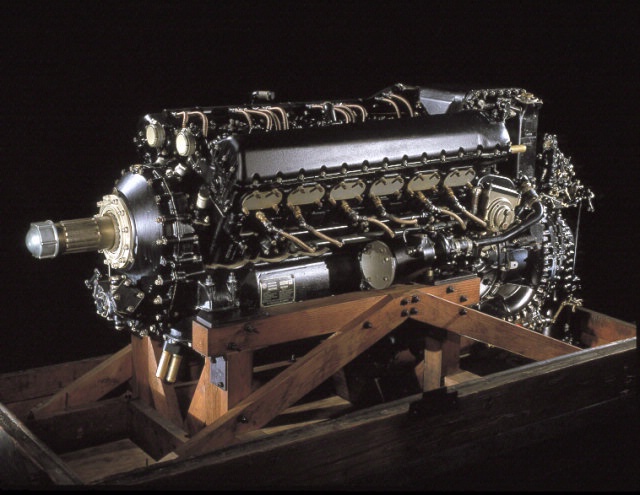
Object Details
Manufacturer
General Electric Aircraft Engines
Physical Description
Type: Turbojet
Thrust: 40,032 N (9,000 lb) at 8,000 rpm
Compressor: 12-stage axial
Combustor: 10 combustion chambers
Turbine: 2-stage axial
Weight: 1,633 kg (3,600 lb)
Summary
GE began design work in 1949 on the XJ47-21 (later J73-GE-3) in response to an Air Force requirement for an all-weather engine capable of attaining 18.2 km (60,000 ft.) altitude. After a problematic development program, the J73 passed its 150-hour military qualification test in 1954. The engine was considered by various manufacturers as a power plant for the Boeing KC-97, Boeing B-47C, Republic F-84, and the Northrop YF-89E aircraft. However, only North American made a commitment for its F-86H fighter.
The J73 produced almost 50 percent more thrust than its J47 predecessor, and was GE's engine to incorporate titanium, a two-stage turbine, variable stators (inlet guide vanes), and cannular combustor. It became operational in the North American F-86H in 1953, powering this aircraft to a world speed record of 1,038 km/hr (649 mph) over a 500 km (313 mile) course. A total of 876 -3 engines were purchased by the Air Force, with production completed in 1956.
Credit Line
Gift of the New England Air Museum
Date
1954
Inventory Number
A19870353000
Restrictions & Rights
Usage conditions apply
Type
PROPULSION-Turbines (Jet)
Dimensions
Length 508 cm (200 in.), Diameter 93.3 cm (36.75in.)
Country of Origin
United States of America
See more items in
National Air and Space Museum Collection
Data Source
National Air and Space Museum
Link to Original Record
Record ID
nasm_A19870353000