
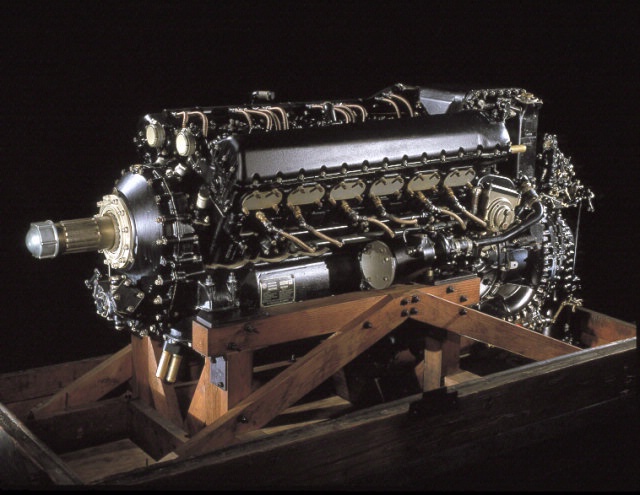
Object Details
Manufacturer
General Electric Aircraft Engines
Physical Description
Type: Turbojet
Thrust: 7,117 N (1,600 lb) at 16,500 rpm
Compressor: Single-stage centrifugal
Combustor: 10 reverse-flow chambers
Turbine: Single-stage axial
Weight: 401 kg (885 lb)
Summary
Early flight tests of the first General Electric turbojet engine, the Type I-A, clearly showed the need for more powerful engines. GE followed with two designs of increased thrust. The second, known as the J31, initially referred to as the I-16, had 7,117 N (1,600 lb) of thrust and first ran in April 1943. GE built about 250 of these versions, mainly for the Bell YP-59 and P-59A and B jet aircraft.
The I-16-5 model was built for the Army Air Forces. It was an improved design derived from the I-16A1 and I-16A3 that incorporated changes to obtain better cooling for the rear bearing for improved performance at high altitude. It also had larger turbine wheel cooling air vanes, a new cooling air manifold assembly, and a flange welded wheel and shaft construction.
Credit Line
Transferred from the U.S. Air Force Museum, Wright-Patterson AFB, Ohio
Date
Circa World War II
Inventory Number
A19600240000
Restrictions & Rights
Usage conditions apply
Type
PROPULSION-Turbines (Jet)
Materials
HAZMAT: Cadmium Plating, Magnesium Alloy
Aluminum
Steel
Rubber
Anodized Aluminum
Rubberized Fabric
Paint
Copper Alloy
Fabric
Adhesive
Ceramic
Dimensions
Length 183 cm (72 in.), Diameter 105 cm (41.5 in.)
Country of Origin
United States of America
See more items in
National Air and Space Museum Collection
Data Source
National Air and Space Museum
Link to Original Record
Record ID
nasm_A19600240000