
Object Details
Manufacturer
Fairchild Engine and Airplane Corporation
Physical Description
Type: Turboprop, 4 units
Power Rating: 7,345 kW (9,850 ehp)
Compressor: 12-stage axial
Combustor: Six through flow can-type
Turbine: 2-axial stages driving compressor, 2-axial stages driving propeller
Weight: 2,815 kg (6,200 lb)
Summary
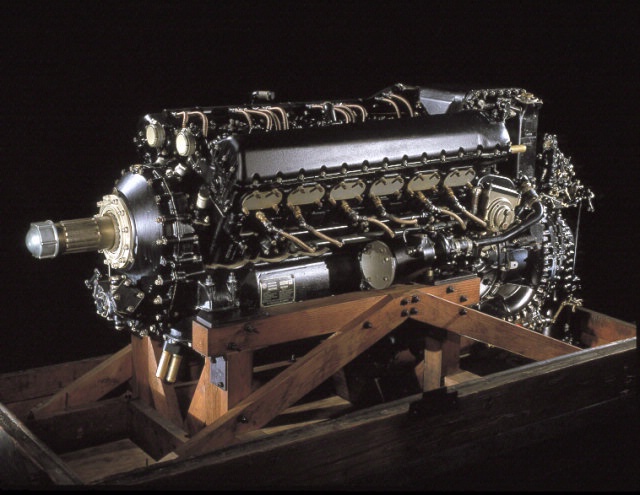
In 1946, the U.S. Navy cancelled its contract for the 24-cylinder, 1,119 kW (1,500 shp) XH-1850 engine under development by the Ranger Aircraft Engine Division of Fairchild Engine and Airplane Corporation. Remaining funds were assigned to study a turboprop engine, with wide variations in configurations. Included were a simple gas turbine; a gas turbine using a regenerative cycle; use of a reheat cycle; and a compound arrangement with one turbine driving the compressor and the other the propeller. Designs were also to be in the context of aircraft missions appropriate for such turbine engines.
The proposed design utilized four power units arranged around a central drive shaft, with each unit incorporating 12 axial-flow compressor stages and 4 axial-flow turbine stages. This artifact is one unit, used for compressor tests. The project was canceled in 1948 due to a Government decision to restrict engineering and design contract awards and funds to a limited number of major engine manufacturers.
Credit Line
Transferred from the U.S. Navy
Date
Circa 1949
Inventory Number
A19710904000
Restrictions & Rights
Usage conditions apply
Type
PROPULSION-Turbines (Jet)
Materials
HAZMAT: Possible Cadmium
Non-Magnetic White Metal
Ferrous Alloy
Paint
Rubber
Adhesive Tape
Dimensions
3-D: 274.3 × 77.6 × 127cm (9 ft. × 2 ft. 6 9/16 in. × 4 ft. 2 in.)
Country of Origin
United States of America
See more items in
National Air and Space Museum Collection
Data Source
National Air and Space Museum
Link to Original Record
Record ID
nasm_A19710904000