
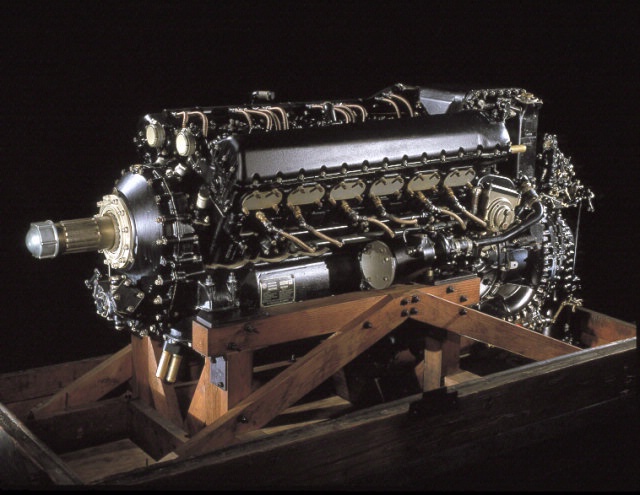
Object Details
Manufacturer
Clerget, Blin and Cie
Physical Description
Type: Rotary, 9 cylinders, air-cooled
Power rating: 96.9 kW(130 hp) at 1,250 rpm
Displacement: 16.3 L (992 cu in.)
Bore and Stroke: 120 mm (4.7 in.) x 160 mm (6.3 in.)
Weight: 173 kg (381 lb)
Summary
Engineering inventor Pierre Clerget and industrialist Eugene Blin established Clerget, Blin and Cie in 1913 in Levallois-Peret, a suburb of Paris, France. The company built both stationary and rotary aircraft engines. Clerget introduced into its rotary engines independently operated intake and exhaust valves. Of the French rotary manufacturers, only Clerget succeeded in bringing into service, toward the end of World War I, engines approaching 149 kW (200 hp). Gwynnes, Ltd., Hammersmith Iron Works in London controlled British manufacturing rights on Clerget engines.
The Clerget 9B powered numerous World War I aircraft types, including the Avro 504C/K/L; Avro 531/A Spider; Bristol 10 M.1.A and 11 M.1.B.; Caudron; Nieuport 12 Fr, 17, 17bis,and Triplane; Sopwith Baby, Triplane, F.1 Camel, Scooter, and LTC 1-1/2 Strutter. This artifact originally powered a British Avro, and was brought into the U.S. by Clarence Chamberlain after World War I, and flown by the donor, Don Coe, in 1927.
Credit Line
Gift of Don Coe
Date
Circa 1917
Inventory Number
A19490062000
Restrictions & Rights
Usage conditions apply
Type
PROPULSION-Reciprocating & Rotary
Materials
Steel
Aluminum
Copper Alloy
Rubber
Paint
Paper
Dimensions
Length 101.6 cm (40 in.), Width 76.2 cm (30 in.), Height 101.6 m (40 in.)
Country of Origin
France
See more items in
National Air and Space Museum Collection
Data Source
National Air and Space Museum
Link to Original Record
Record ID
nasm_A19490062000