
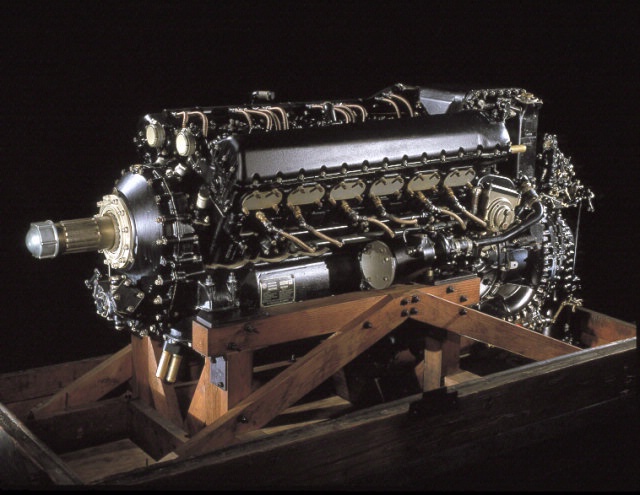
Object Details
Manufacturer
BMW (Bayerische Motoren Werke)
Physical Description
Type: Reciprocating, 14 cylinders, 2 rows, turbosupercharged, radial, air-cooled
Power rating: 1,268 kW (1,700 hp) at 2,700 rpm
Displacement: 42 L (2,562 cu. in.)
Bore and Stroke: 156 mm (6.2 in.) x 156 mm (6.2 in.)
Weight: 2,041 kg (4,500 lb)
Summary
The BMW 801 was the first German high-performance, air-cooled radial engine of new design introduced after the start of World War II. Introduction of a cooling fan in the cowl nose opening, operating at approximately three times propeller speed and with internal baffles, made it possible to eliminate all external cowling enlargements. In most installations, the exhaust pipes were grouped to give ejector thrust, and reduced installed drag below that of an equivalent liquid-cooled engine.
The 801 incorporated an automatic two-speed, single-stage centrifugal supercharger, direct fuel injection, and single-lever operation of manifold pressure, engine speed, ignition timing, and blower speed. The 801A went into production in 1940 at 1,193 kW (1,600 shp). Later turbosupercharged models culminated in the TQ rated at 1,279 kW (1,715 shp) at 1,219 m (40,000 ft). Total production exceeded 61,000 engines.
The BMW 801TJ powered later models of the Focke-Wulf Fw 190 and Junkers Ju 88.
Credit Line
Transferred from the U.S. Navy
Date
Circa World War II
Inventory Number
A19710935000
Restrictions & Rights
Usage conditions apply
Type
PROPULSION-Reciprocating & Rotary
Materials
Ferrous Alloy
Non-Magnetic White Metal
Plastic
Paint
Adhesive Tape
Dimensions
3-D: 281.9 × 138.4 × 152.4cm (9 ft. 3 in. × 4 ft. 6 1/2 in. × 5 ft.)
Country of Origin
Germany
See more items in
National Air and Space Museum Collection
Data Source
National Air and Space Museum
Link to Original Record
Record ID
nasm_A19710935000