
Object Details
Summary
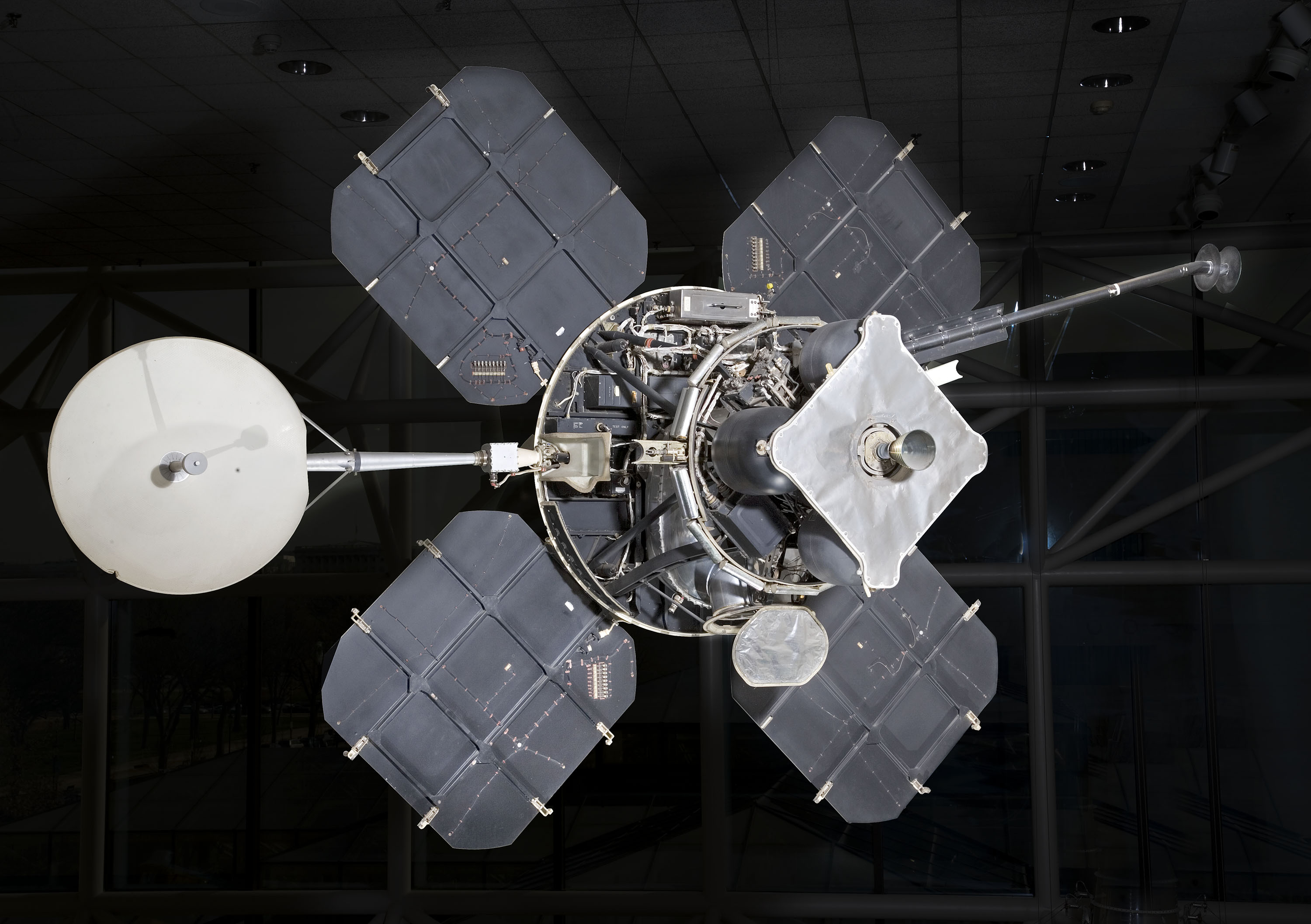
Rangers 1 and 2 carried micrometeorite detectors (also called “cosmic dust detectors”) aboard their brief flights. Made of a stainless steel, aluminum, as well as gold plating, rubber, and plastic, the detector fit into the hexagonal base of the Ranger spacecraft. Designed by scientist W. M. Alexander of NASA’s Goddard Space Flight Center, the device’s objective was to study the relationship of micrometeorite’s density as compared with their mass and velocity. However, the leaders of Project Ranger at the Jet Propulsion Laboratory rated the micrometeorite detector low on the Ranger’s priority-list of scientific experiments, and the experiment did not continue beyond Block I (of V) in the program.
NASA's Jet Propulsion Laboratory transferred this detector to the Museum in 1976.
Credit Line
Transferred from the National Aeronautics and Space Administration
Inventory Number
A19761260000
Restrictions & Rights
Usage conditions apply
Type
SPACECRAFT-Uncrewed-Instruments & Payloads
Materials
Stainless Steel
Aluminum
Gold Plating
Synthetic Rubber
Plastic
Ink
Dimensions
Overall: 19.1 x 26.3 x 19.1cm (7 1/2 x 10 3/8 x 7 1/2 in.)
Country of Origin
United States of America
See more items in
National Air and Space Museum Collection
Data Source
National Air and Space Museum
Link to Original Record
Record ID
nasm_A19761260000