
Object Details
Designer
D.J. Deschamps
Manufacturer
Lambert Engine and Machine Company
Physical Description
Type: Reciprocating, 12 cylinders, V-type, Two-stroke cycle, Diesel, Inverted, Liquid cooled, supercharged
Power rating: 895 kW (1,200 hp) at 1,600 rpm
Displacement: 50 L (3,052 cu in)
Bore and Stroke: 152 mm (6 in.) x 229 mm (9 in.)
Weight (dry): 1,089 kg (2,400 lb)
Summary
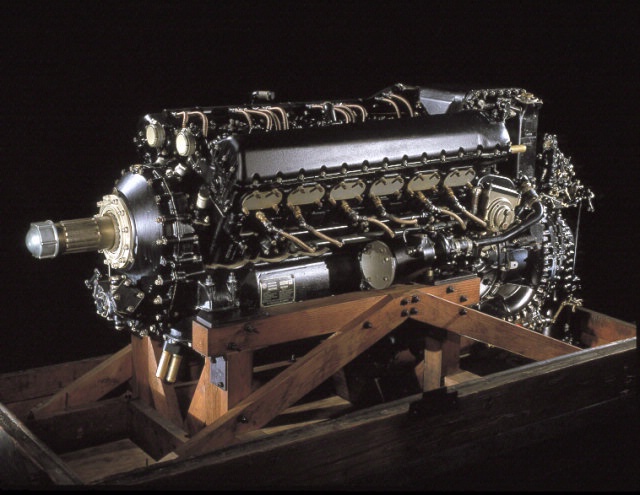
In 1929, D. J. Deschamps, formerly associated with a Belgian manufacturer, constructed a 2-cylinder Diesel test engine. Later, in early 1934, it was announced that Deschamps had designed a Diesel aircraft engine, designated V 3050 for its V-type and displacement. Built by the Lambert Engine and Machine Company in Moline, Illinois, as an experimental airship or trans-oceanic flying boat engine, it was one of the largest Diesel types for aircraft proposed up to that time.
Utilizing a liquid-cooled, two-stroke cycle, the inverted V-12 Diesel Deschamps engine also incorporated direct fuel injection and dual General Electric superchargers. Due to the narrow angle between its cylinder banks, it had a low frontal area. In order to accommodate airship requirements, the engine was fully reversible when operating. While a technically promising engine, financial difficulties prevented continued development and flight testing.
Credit Line
Transferred from the U.S. Navy
Date
Circa 1934
Inventory Number
A19710926000
Restrictions & Rights
Usage conditions apply
Type
PROPULSION-Reciprocating & Rotary
Materials
Steel, Aluminum, Paint, Rubber, Copper
Dimensions
Length 266.7 cm (105 in.), Width 67.3 cm (26.5 in.), Height 125.9 cm (49.565 in.) (approximate dimensions)
Country of Origin
United States of America
See more items in
National Air and Space Museum Collection
Data Source
National Air and Space Museum
Link to Original Record
Record ID
nasm_A19710926000