
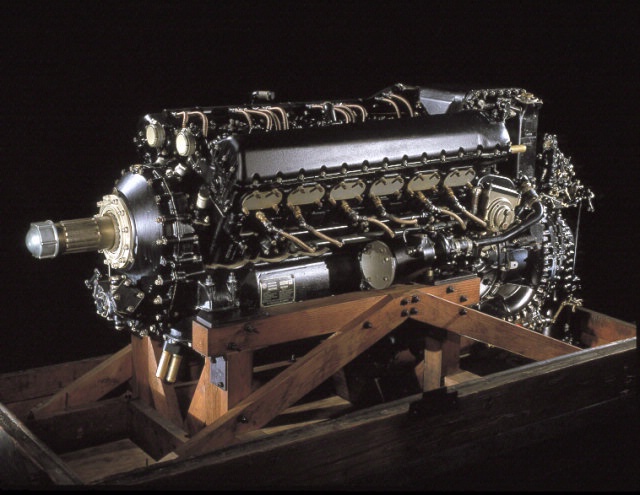
Object Details
Manufacturer
DePalma Manufacturing Company (Detroit, Michigan)
Physical Description
Type: Reciprocating, 4 cylinders, V-type, air cooled
Power rating: 28-37 kW (38-50 hp)
Displacement: Unknown
Bore and Stroke: Unknown
Weight: Unknown
Summary
C.H. Willis, Henry Ford’s Chief Engineer, who also led the DePalma Manufacturing Company, worked with famous inventor and General Motors executive Charles F. Kettering to develop this engine under an Army contract for the Kettering Bug, a flying bomb. This predecessor for later cruise missiles used a two-cycle engine because of its high power-to-weight ratio, simplicity of construction, and low cost. With twice the explosions, a two-cycle engine can produce higher power than a four-cycle engine, but does not throttle well, which was not important for this application.
The Bug was to cost about $575 in large quantities, and have a range of fifty miles. Development of the aircraft was begun in 1918; but did not go into production because of largely unsuccessful flight tests in 1918 and 1919. The engine also powered Dayton-Wright aircraft such as the T-4 Messenger, another prototype aircraft that lost favor following World War I.
Credit Line
Transferred from the War Department, Air Corps, Materiel Division, Wright Field, Dayton, Ohio
Date
Circa 1918
Inventory Number
A19340009000
Restrictions & Rights
CC0
Type
PROPULSION-Reciprocating & Rotary
Materials
Steel, Paint, Aluminum, Preservative coating
Dimensions
Depth 71.1 cm (28 in.), Length 87.6 cm (34.5 in.), Width 101.6 cm (40 in.)
Country of Origin
United States of America
See more items in
National Air and Space Museum Collection
Data Source
National Air and Space Museum
Link to Original Record
Record ID
nasm_A19340009000