
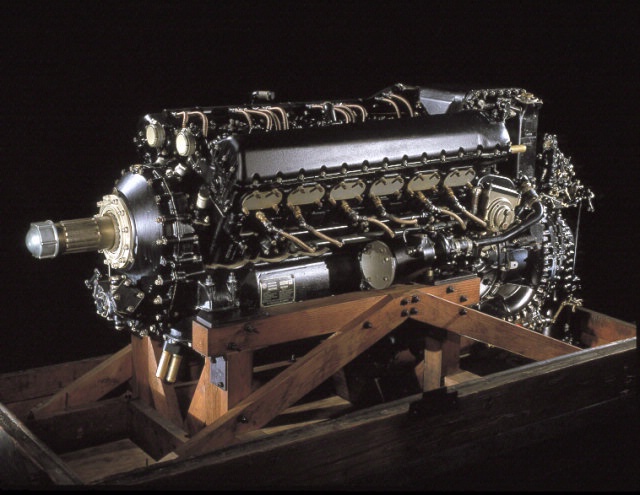
Object Details
Manufacturer
Allis-Chalmers Mfg. Co.
Designer
De Havilland Engine Company, Ltd
Physical Description
Type: Turbojet
Thrust: 13,344 N (3,000lb) at 10,200 rpm
Compressor: Single-stage centrifugal
Combustor: 16 straight-through-flow chambers
Turbine: Single-stage axial
Weight: 680 kg (1,500 lb)
Summary
Design of the de Havilland H-1 Goblin turbojet began in April 1941, and its first test flight, in March 1943, was also the maiden flight of the Gloster Meteor. In early 1943, a British delegation visited U.S. gas turbine manufacturers, revealed details of British research, and discussed the possibility of building the H-1 turbojet in the U.S. Allis-Chalmers was ultimately awarded a contract in 1944 for the construction of 40 H-1 engines, although the first American H-1 engines were imported in July 1943 for Navy development of the Curtiss XF15C airplane, which flew with an H-1 in its tail and a Pratt & Whitney R-2800 in the nose.
The Army Air Forces also used an H-1 engine as the power plant in the prototype XP-80, which first flew in January 1944. However, the P-80's H-1 engine was later replaced by the more powerful GE I-40 (J33) shortly before the end of World War II.
Credit Line
Transferred from the U.S. Navy, Naval Supply Center, Cheatham Annex, Williamsburg, Virginia
Date
Circa 1945
Inventory Number
A19731566000
Restrictions & Rights
Usage conditions apply
Type
PROPULSION-Turbines (Jet)
Materials
HAZMAT: Possible Cadmium
Non-Magnetic White Metal
Ferrous Alloy
Rubber
Possible Asbestos
Wood
Plastic
Paper
Unidentified Coating
Paint
Copper Alloy
Adhesive Tape
Ink
Dimensions
3-D: 281.9 × 123.2 × 137.2cm, 680.4kg (9 ft. 3 in. × 4 ft. 1/2 in. × 4 ft. 6 in., 1500lb.)
Country of Origin
United States of America
United Kingdom
See more items in
National Air and Space Museum Collection
Data Source
National Air and Space Museum
Link to Original Record
Record ID
nasm_A19731566000