
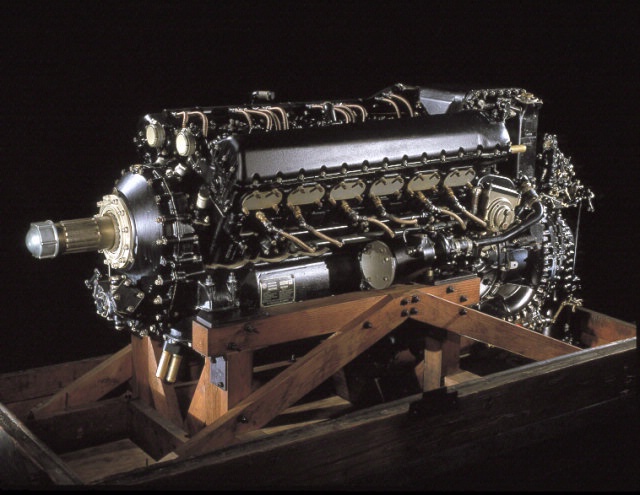
Object Details
Manufacturer
Curtiss Aeroplane and Motor Company
Physical Description
Type: Reciprocating, 8 cylinders, V-type, Liquid cooled
Power rating: 76 kW (100 hp) at 1,400 rpm
Displacement: 9.3 L (567cu in.)
Bore and Stroke: 108 mm (4.3 in.) x 127 mm (5 in.)
Weight: 181.9 kg (401 lb)
Summary
Among the most successful early engines marketed in the United States were those designed and built by aviation pioneer and inventor Glenn Curtiss. Early Curtiss engines were designed to power motorcycles. The first Curtiss aircraft engines were air cooled but, to achieve higher power, Curtiss began to develop liquid-cooled engines.
With the advent of World War I, Curtiss concentrated its production on the famous 67 kW (90 hp) OX-5 engine which powered the JN-4D “Jenny” trainer aircraft. The OXX-6 engine was an improved version of the OX-5. Differences from the OX-5 included two magnetos (instead of one) for greater dependability and a slightly larger cylinder bore giving an additional 7.5 kW (10 horsepower). During World War I, the OXX-6 was used on such Curtiss aircraft as the Model N9 hydroplane. Together, the OX-5 and OXX-6 were the most extensively used American-built engines during World War I and in the following decade.
Credit Line
Gift of the Massachusetts Institute of Technology
Date
Circa World War I
Inventory Number
A19610019000
Restrictions & Rights
Usage conditions apply
Type
PROPULSION-Reciprocating & Rotary
Materials
steel, wood, aluminum, paint, copper, rubber, ceramic, Nickel plating, Textile
Dimensions
Overall: 139.7 × 78.7 × 78.7cm (55 × 31 × 31 in.)
Storage: 165.1 × 104.1 × 91.4cm (65 × 41 × 36 in.)
Country of Origin
United States of America
See more items in
National Air and Space Museum Collection
Data Source
National Air and Space Museum
Link to Original Record
Record ID
nasm_A19610019000