
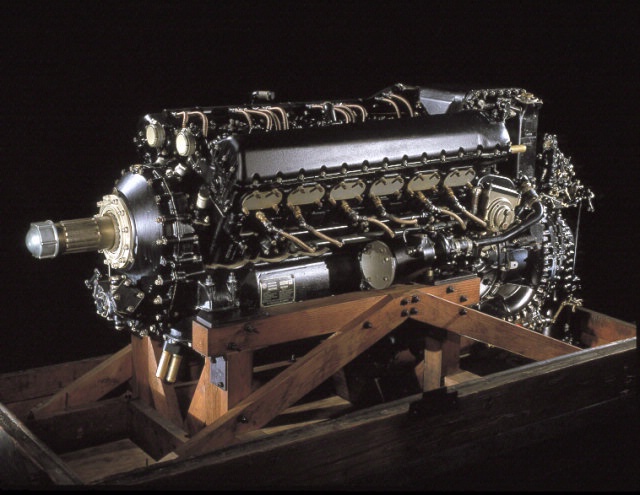
Object Details
Manufacturer
Curtiss Aeroplane and Motor Company
Physical Description
Type: Reciprocating, V-type, 8 cylinders, water-cooled
Power rating: 48.5 kW (65 hp) at 1,150 rpm
Displacement: 8.2 L (502.64 cu in)
Bore and Stroke: 102 mm (4 in.) x 127 mm (5 in.)
Weight: 129 kg (285 lb)
Summary
Curtiss was one of the most successful early American aircraft engine manufacturers. The first Curtiss engines were air cooled but, to achieve higher power, Curtiss began to develop liquid-cooled engines. Historical evidence suggests that this Model L artifact was one of two higher-performance engines built by Curtiss for his experimental monoplane that was shown, but not flown, at the 1910 Gordon Bennett Race held at Belmont Park, N.Y. Both engines were later assigned to Eugene Ely, a pilot for Curtiss, who used them in exhibition and demonstration flights. It is likely that one of those engines powered the aircraft which crashed in 1912 at Macon, Georgia, killing Ely.
Continued evolution of the Curtiss V-8 engine led to the OX-5, of which more than 10,000 were produced by the end of World War I in 1918. The U.S. government sold thousands of these to the public as surplus at a fraction of their original cost.
Credit Line
Transferred from the Department of the Navy, Bureau of Aeronautics
Date
Circa 1910
Inventory Number
A19510059000
Restrictions & Rights
CC0
Type
PROPULSION-Reciprocating & Rotary
Materials
Steel, Preservative coating, Paint, Aluminum, Brass
Dimensions
Depth 90.2 cm (35.5 in.), Length 109.2 cm (43 in.), Width 80.6 cm (31.75 in.)
Country of Origin
United States of America
See more items in
National Air and Space Museum Collection
Data Source
National Air and Space Museum
Link to Original Record
Record ID
nasm_A19510059000