
Object Details
Manufacturer
Curtiss Aeroplane and Motor Company
Physical Description
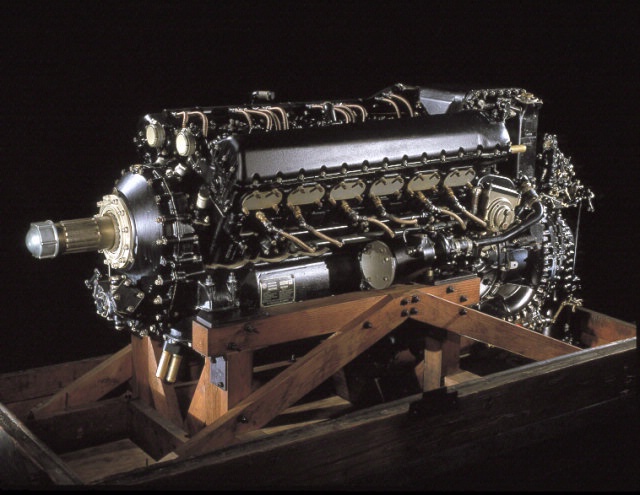
Type: Reciprocating, 6 cylinders, in-line, water-cooled
Power rating: 112 kW (150 hp) at 1,700 rpm
Displacement: 9.38 L (572.54 cu in)
Bore and Stroke: 114 mm (4.5 in.) x 152 mm (6 in.)
Weight: 189.1 kg (417 lb)
Summary
Among the most successful early engines marketed in the United States were those designed and built by aviation pioneer and inventor Glenn H. Curtiss in his factory in Hammondsport, New York. The earliest Curtiss designed engines powered his racing motorcycles. The first Curtiss aircraft engine, a 5.2 kW (7 hp) air cooled, V-twin, powered a small dirigible in 1904.
During 1917 and 1918, the Curtiss K-6 (Kirkham-6) was designed under the direction of Charles B. Kirkham, an associate of Curtiss for a number of years who became the company’s Chief Engineer. Following the K-12, a Curtiss competitor for the highly successful Hispano-Suiza engine, the K-6 was introduced as a six-cylinder vertical direct-drive engine using the same cylinder block and the same crankshaft dimensions. Closely following the design of the K-12, the K-6 used K-12 parts wherever possible. Three K-6 engines powered the 1919 tri-motor Curtiss Eagle II airliner.
Credit Line
Transferred from the Department of the Navy, Bureau of Aeronautics
Date
Circa 1918
Inventory Number
A19520105000
Restrictions & Rights
Usage conditions apply
Type
PROPULSION-Reciprocating & Rotary
Materials
Aluminum, Steel, Copper, Rubber, Preservative Coating, Paint, Nickel plating, Textile
Dimensions
Height 119.4 cm (47 in.), Width 81.3 cm (32 in.), Depth 168.9 cm (66.5 in.)
Country of Origin
United States of America
See more items in
National Air and Space Museum Collection
Data Source
National Air and Space Museum
Link to Original Record
Record ID
nasm_A19520105000