
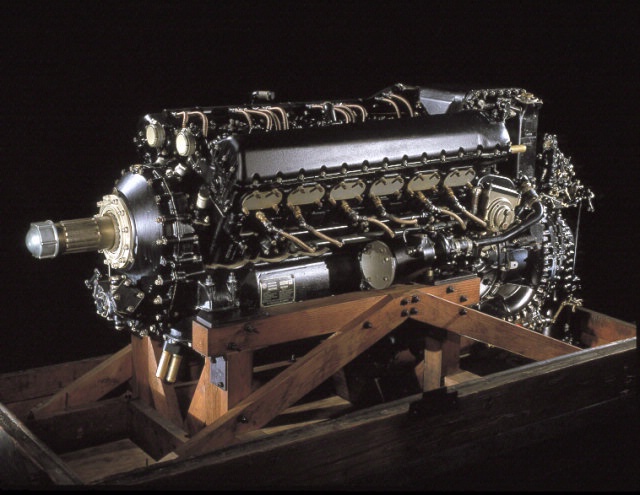
Object Details
Manufacturer
Curtiss Aeroplane and Motor Company
Physical Description
Type: Reciprocating, 12 cylinders, V-type, water cooled
Power rating: 280 kW (375 hp) at 2,250 rpm
Displacement: 18.8 L (1,145.09 cu in.)
Bore and Stroke: 114 mm (4.5 in.) x 152 mm (6 in.)
Weight: 307.5 kg (678 lb)
Summary
In 1916 Curtiss engineer Charles Kirkham began designing an engine to compete with the Wright Corporation's Hispano-Suiza. By late 1917, the prototype K-12 (K for Kirkham) was bench tested. While it met its design objectives of high power, low frontal area, compact size, and low weight, the engine encountered technical difficulties during development. Kirkham left Curtiss in 1919, and Arthur Nutt took over the project, eventually producing the D-12, which became a highly successful racing and military power plant in the 1920s.
This engine is manufacturer's number 5 out of about 20 built. The K-12 powered the Curtiss Navy 18T Wasp triplane and the Army Curtiss 18B Hornet biplane. In 1919 Curtiss test pilot Roland Rholfs set a new world's altitude record of 10,641 m (34,910 ft) with the 18T.
Credit Line
Transferred from the U.S. Navy
Date
Circa 1918
Inventory Number
A19710907000
Restrictions & Rights
CC0
Type
PROPULSION-Reciprocating & Rotary
Materials
Steel, Aluminum, Paint, Preservative coating, Rubber, Ceramic, Copper, Brass, Phenolic
Dimensions
Length 152.4 cm (60 in.) (approximate), Width 70.8 cm (27.875 in.), Height 101.9 cm (40.125 in.)
Country of Origin
United States of America
See more items in
National Air and Space Museum Collection
Data Source
National Air and Space Museum
Link to Original Record
Record ID
nasm_A19710907000