
Object Details
Manufacturer
Curtiss Aeroplane and Motor Company
Physical Description
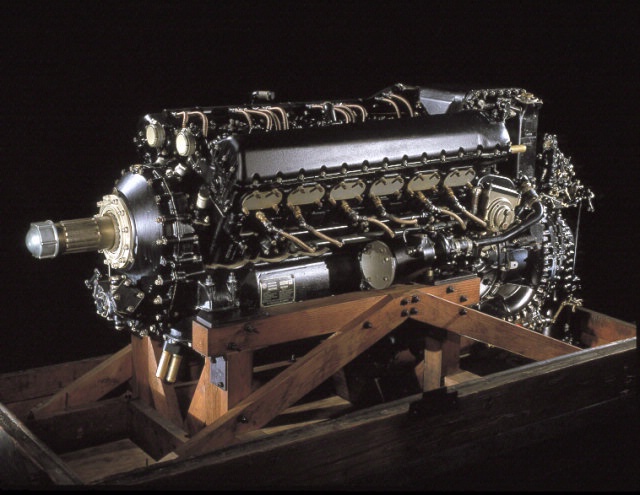
Type: Reciprocating, 12 cylinders, 2 rows, radial, air cooled
Power rating: 447 kW (600 hp) at 2,200 rpm
Displacement: 26.9 L (1,640.1 cu in)
Bore and Stroke: 143 mm (5.625 in.) x 140 mm (5.5 in.)
Weight: 415 kg (915 lb)
Summary
Among the most successful early engines marketed in the United States were those designed and built by aviation pioneer and inventor Glenn Curtiss of Hammondsport, New York. Early Curtiss engines were designed to power motorcycles. In 1904 a two-cylinder, V-type motorcycle engine, believed to be the first Curtiss aircraft engine, was modified to power Capt. Thomas S. Baldwin's California Arrow, a small dirigible.
In 1926, Curtiss began the design of a 12-cylinder, two-row engine, the H-1640, that it hoped would surpass the performance of Pratt & Whitney's Wasp engine while having a considerably smaller frontal area. It had cylinders of the second row directly behind those of the first row, and the valves were operated by an overhead camshaft for each pair of cylinders. The H-1640 was certificated on September 13, 1928. The H-1640 powered the Curtiss P-11, Thomas-Morse XP-13, and Curtiss XP-14 aircraft. However, partly because of its extremely small diameter, this engine was not very successful.
Credit Line
Transferred from the U.S. Navy
Date
Circa 1928
Inventory Number
A19710917000
Restrictions & Rights
CC0
Type
PROPULSION-Reciprocating & Rotary
Dimensions
Other: 45 5/16 x 51 11/16 x 51 x 65 x 55in. (115.1 x 131.3 x 129.5 x 165.1 x 139.7cm)
Approximate (On stand): 638.7kg (1408lb.)
Country of Origin
United States of America
See more items in
National Air and Space Museum Collection
Data Source
National Air and Space Museum
Link to Original Record
Record ID
nasm_A19710917000