
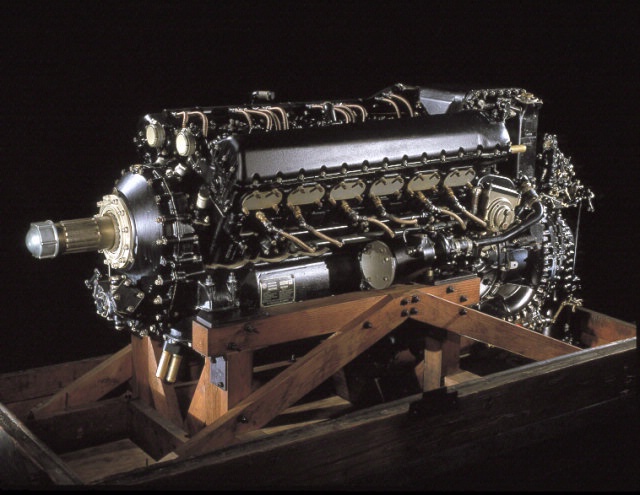
Object Details
Manufacturer
Curtiss Aeroplane and Motor Company
Physical Description
Type: Reciprocating, V-type, 12 cylinders, liquid-cooled
Power rating: 242 kW (325 hp) at 1,800 rpm
Displacement: 18.8 L (1,145.09 cu in.)
Bore and Stroke: 114 mm (4.5 in.) x 152 mm (6 in.)
Weight: 437.7 kg (964 lb)
Summary
The CD-12 (Curtiss Direct-Drive) history extended over several years. Development began in 1915 with the K-12, using the historic design skills of Charles Kirkham; and in competition with the popular Hispano-Suiza. The high power and low weight goal was a great challenge. So it was not surprising that the aluminum monoblock and several other advanced features, including the reduction gearing, presented substantial problems. Unable to overcome these difficulties, Kirkham left Curtiss in 1919, and his successor, Arthur Nutt produced a derated CD-12, without the reduction gearing of the K-12, in 1921.
This artifact was a production prototype, while the other three in its series were sold to the U.S. Navy. In November, 1921, the Navy Curtiss Racer CR-1, powered by a Curtiss CD-12 engine, won the Pulitzer Trophy. CD-12 engines also powered the Curtiss CT Torpedodropper and Navy Curtiss 18T triplane racer. Further development produced the 1922 D-12, a successful engine for both racing and fighter aircraft.
Credit Line
Transferred from the U.S. Navy
Date
Circa 1921
Inventory Number
A19710888000
Restrictions & Rights
Usage conditions apply
Type
PROPULSION-Reciprocating & Rotary
Materials
Aluminum, Steel, Copper, Ceramic, Rubber, Magnesium, Preservative coating
Dimensions
Height 88.4 cm (34.8 in.), Length 144.3 cm (56.8 in.), Width 71.9 cm (28.3 in.)
Country of Origin
United States of America
See more items in
National Air and Space Museum Collection
Data Source
National Air and Space Museum
Link to Original Record
Record ID
nasm_A19710888000