Object Details
Manufacturer
Curtiss Aeroplane and Motor Company
Designer
Glenn H. Curtiss
Physical Description
Type: Reciprocating, V-type, 8 cylinders, air-cooled
Power rating: 29.8 kW (40 hp) at 1,800 rpm
Displacement: 4.393 L (268 cu in.)
Bore and Stroke: 92.08 mm (3.625 in.) x 82.55 mm (3.25 in.)
Weight: 68.1 kg (150 lb)
Summary
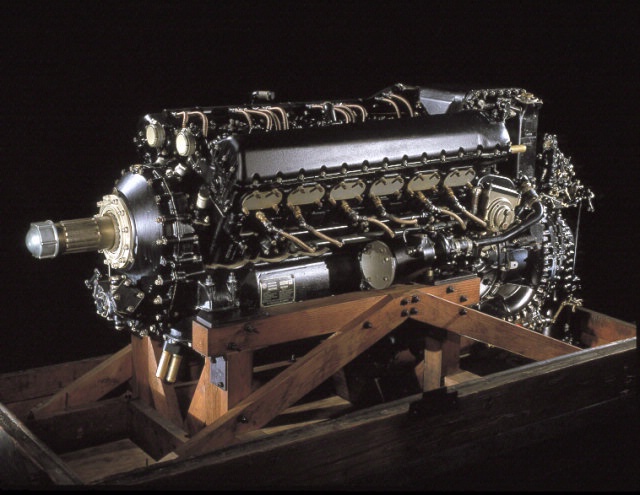
Among the most successful early engines marketed in the United States were those designed and built by aviation pioneer and inventor Glenn Curtiss in his factory in Hammondsport, New York. Early Curtiss engines were designed to power motorcycles. The Curtiss Model B-8 was the first Curtiss engine to power a heavier-than-air machine in sustained flight. In 1908, the 29.8 kw (40 hp) B-8 powered the Curtiss June Bug aircraft. In 1911, this engine was used by the donor's father, Dr. George A. Spratt, to power an experimental variable angle of incidence wing seaplane of his own design.
Although this engine is air cooled, all Curtiss engines manufactured after 1908 were water cooled.
Credit Line
Gift of George Spratt
Date
1907
Inventory Number
A19490009000
Restrictions & Rights
Usage conditions apply
Type
PROPULSION-Reciprocating & Rotary
Materials
Metal
Dimensions
3-D: 78.7 × 49.5 × 43.2cm (2 ft. 7 in. × 1 ft. 7 1/2 in. × 1 ft. 5 in.)
Support: 46.4 × 68.6 × 42.5cm (18 1/4 in. × 27 in. × 16 3/4 in.)
Country of Origin
United States of America
See more items in
National Air and Space Museum Collection
Location
National Air and Space Museum in Washington, DC
Exhibition
Early Flight
Data Source
National Air and Space Museum
Link to Original Record
Record ID
nasm_A19490009000