
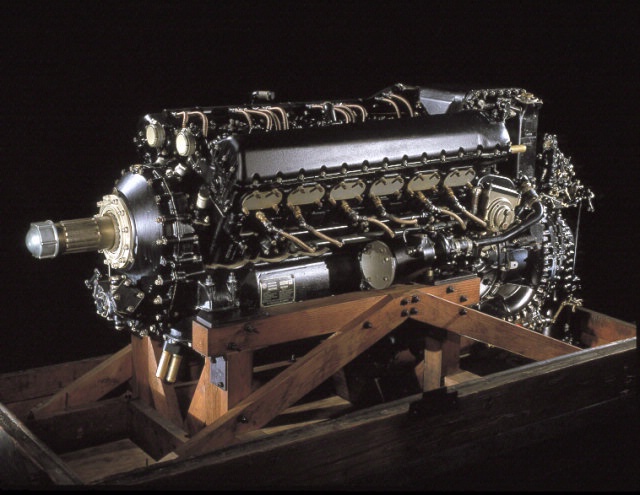
Object Details
Manufacturer
Continental, Inc.
Physical Description
Type: Reciprocating, 7 cylinders, single row, radial, air-cooled
Power rating: 261 kW (350 hp) at 2,000 rpm
Displacement: 13.0 L (794 cu in.)
Bore and Stroke: Not available
Weight: 259 kg (571 lb)
Summary
Continental, a successful manufacturer of automotive engines, purchased the rights for a Burt-McCollum single-sleeve valve engine design in 1925. Believing this technology might replace poppet valves in aircraft engines, Continental announced the R-790 engine in 1927, which was a 220 horsepower 9-cylinder Wright radial engine incorporating single-sleeve valves. It was never fully tested. The follow-on 350 horsepower 7-cylinder R-794 was a dedicated sleeve-valve design and incorporated a supercharger. The U.S. Navy ordered five R-794s in August 1934 and tested them, but the type never went into production.
Between 1935 and 1945, the Navy later sponsored a number of unconventional engine designs; however, few entered production. In February 1939, the U.S. Navy contracted with Continental for the development of one 875 horsepower XR-1740-2. It was a 14-cylinder, air-cooled radial engine that incorporated sleeve-valve cylinders, direct fuel injection, and a single-speed centrifugal supercharger.
The American military typically awarded development contracts to small manufacturers interested in entering the aircraft engine field or in expanding their product line in a particular area. Many of these developments showed promise, but few materialized into usable combat engines. In some instances, the smaller engines were outmoded by increasing power requirements. In other instances, the talent and facilities of the manufacturers did not prove equal to the task of gaining a foothold in a highly competitive field. Other developments were curtailed when it became apparent that they would not materialize in time to be of use during the war, and it became necessary to concentrate effort on models capable of early combat application.
Credit Line
Transferred from the U.S. Navy
Date
Circa 1937
Inventory Number
A19710898000
Restrictions & Rights
Usage conditions apply
Type
PROPULSION-Reciprocating & Rotary
Materials
Ferrous Alloy
Non-Magnetic Metal
Unknown Coating
Paint
Solder
Copper Alloy
Dimensions
Diameter 99.1 cm (39.0 in.), Length 101.9 cm (40.13 in.)
Country of Origin
United States of America
See more items in
National Air and Space Museum Collection
Data Source
National Air and Space Museum
Link to Original Record
Record ID
nasm_A19710898000