
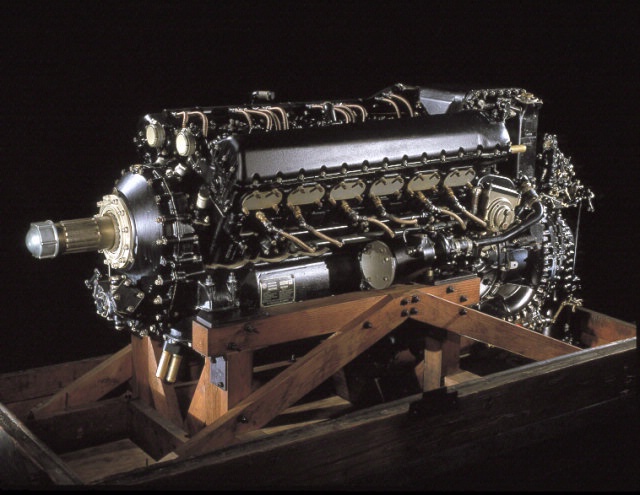
Object Details
Manufacturer
Continental, Inc.
Physical Description
Type: Reciprocating, 6 cylinders, Horizontally opposed, Air-cooled
Power rating: 179 kW (240 hp) at 2,600 rpm
Displacement: 7.72 L (471 cu in)
Bore and Stroke: 127 mm (5 in.) x 101.6 mm (4 in.)
Weight: 183.3 kg (404 lb)
Summary
Once the largest independent manufacturer of automotive engines, Detroit’s Continental Motors Corporation purchased the rights to a single-sleeve valve engine design in 1925, believing this technology might replace poppet valves in aircraft engines. However, after considerable testing with U.S. Navy support, the company only became successful in aviation after reverting to poppet valves.
Continental’s future success began in 1931 when it began production of four cylinder horizontally opposed engines. For example, the Continental A-40 made the classic Piper Cub possible. Today the opposed engine design has replaced all other types of piston engines for various reasons, including fewer cylinders for equal power and smooth running. And Continental is one of the world’s largest manufacturers of general aviation engines.
O-470 general aviation applications include the Cessna 180, 182, and 310 and Beech Bonanza H35. Military aircraft applications include the Beech T-34, Navion L-17, and Cessna L-19 and O-1. This O-470-11B powered U.S. Marine Corps OE (Cessna Bird Dog) aircraft.
Credit Line
Transferred from the U.S. Marine Corps, Marine Corps Air-Ground Museum and Museums Branch Activities, Quantico, Virginia
Date
Circa 1950s-1960s
Inventory Number
A19870200000
Restrictions & Rights
Usage conditions apply
Type
PROPULSION-Reciprocating & Rotary
Materials
HAZ MAT: Possible Cadmium
Aluminum Alloys
Ferrous Alloys
Rubber
White Metals
Dimensions
Overall: 2 ft. 3 3/4 in. × 2 ft. 9 9/16 in. × 3 ft., 404lb. (70.5 × 85.3 × 91.5cm, 183.3kg)
Country of Origin
United States of America
See more items in
National Air and Space Museum Collection
Data Source
National Air and Space Museum
Link to Original Record
Record ID
nasm_A19870200000