
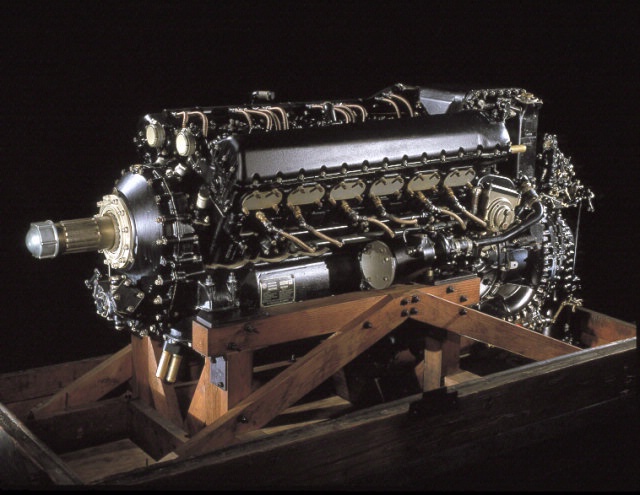
Object Details
Manufacturer
Continental Aviation and Engineering Corporation (Detroit, Michigan)
Designer
Continental, Inc.
Physical Description
Type: Reciprocating, V-type, 12 cylinders, water-cooled
Power rating: 2,386 kW (3,200 hp) at 3,200 rpm
Displacement: 23.4 L (1,426 cu in.)
Bore and Stroke: 140 mm (5.5 in.) x 127 mm (5 in.)
Weight: 732.6 kg (1,615 lb)
Summary
In 1932, the Army contracted with Continental for the engineering and development of a cylinder with high specific power. Using the resulting Hyper No. 1 cylinder, the Air Corps instructed Continental in 1934 to develop what became the horizontally opposed O-1430 to be buried in the wings of large aircraft to improve streamlining for higher speed. However, the Air Corps decided in 1938 that 746 kW (1,000 hp) engines were obsolete for bombers.
Although fighter wings were too thin for a submerged installation, the Air Corps instructed Continental in 1939 to drop the 0-1430 and begin work on the inverted vee I-1430 for improved visibility. But following development problems, it was decided in 1943 that the engine could not possibly be used in the war, and only eight engines were built for experimental use. This Continental I-1430-11 was test flown in a modified Lockheed P-38 testbed aircraft.
Credit Line
Transferred from the U.S. Air Force, Wright-Patterson AFB, Ohio.
Date
Circa World War II
Inventory Number
A19660010000
Restrictions & Rights
Usage conditions apply
Type
PROPULSION-Reciprocating & Rotary
Materials
Steel, Aluminum, Paint, Copper, Rubber, Preservative coating, Magnesium, Cadmium Plating, Plastic
Dimensions
Overall (Weight on Stand): 33 7/16 × 30 7/8 × 112 in., 1615lb. (85 × 78.4 × 284.5cm, 732.6kg)
Approximate: 1049.6kg (2314lb.)
Height 85 cm (33.4 in.), Width 78.4 cm (30.9 in.), Depth 284.5 cm (112 in.)
Country of Origin
United States of America
See more items in
National Air and Space Museum Collection
Data Source
National Air and Space Museum
Link to Original Record
Record ID
nasm_A19660010000