
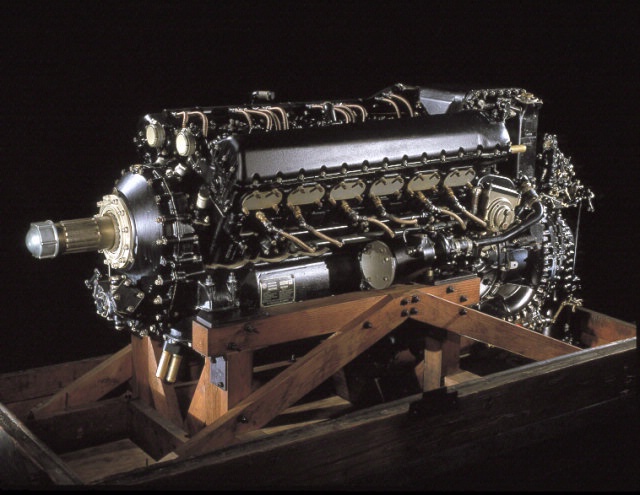
Object Details
Manufacturer
Continental, Inc.
Physical Description
Type: Reciprocating, 4 cylinders, Horizontally-opposed, Air-cooled
Power rating: 56 kW (75 hp) at 2,275 rpm
Displacement: 3.1 L (188 cu in)
Bore and Stroke: 103 mm (4.1 in.) x 92 mm (3.6 in.)
Weight: 84.4 kg (186 lb)
Summary
Once the largest independent manufacturer of automotive engines, Detroit’s Continental Motors Corporation purchased the rights to a single-sleeve valve engine design in 1925, believing this technology might replace poppet valves in aircraft engines. However, after considerable testing with U.S. Navy support, the company only became successful in aviation after reverting to poppet valves. Continental’s future success began in 1931 when it began production of four cylinder horizontally opposed engines.
Derived from the earlier A-50 and A-65 engines and designed by the innovator Harold A. Morehouse, the Continental A-75-3 engine was certificated in 1939. The bore and stroke was the same, and the higher power of the A-75 resulted from increased speed. Early in 1940, Continental introduced a fuel injection system adaptable to the A-65, A-75, and A-80 engines. The A-75 powered light Stinson, Piper, and Luscombe aircraft. Introduced following World War II, the larger bore C-75 powered the Erco Ercoupe 415.
Credit Line
Transferred from the U.S. Navy
Date
Circa World War II
Inventory Number
A19731599000
Restrictions & Rights
Usage conditions apply
Type
PROPULSION-Reciprocating & Rotary
Materials
Ferrous Alloys
Copper Alloy
Aluminum Alloys
Paints
Adhesive Tape
Paper
Dimensions
Approximate: 88.9 × 64.8 × 61cm (2 ft. 11 in. × 2 ft. 1 1/2 in. × 2 ft.)
Storage: 92.7 × 98.4 × 69.8cm (3 ft. 1/2 in. × 3 ft. 2 3/4 in. × 2 ft. 3 1/2 in.)
Country of Origin
United States of America
See more items in
National Air and Space Museum Collection
Data Source
National Air and Space Museum
Link to Original Record
Record ID
nasm_A19731599000