Skip to main content Skip to main navigation
heart-solid My Visit Donate
Home Smithsonian Institution IK development site for ODI
Press Enter to activate a submenu, down arrow to access the items and Escape to close the submenu.
    • Overview
    • Museums and Zoo
    • Entry and Guidelines
    • Museum Maps
    • Dine and Shop
    • Accessibility
    • Visiting with Kids
    • Group Visits
    • Overview
    • Exhibitions
    • Online Events
    • All Events
    • IMAX & Planetarium
    • Overview
    • Topics
    • Collections
    • Research Resources
    • Stories
    • Podcasts
    • Overview
    • For Caregivers
    • For Educators
    • For Students
    • For Academics
    • For Lifelong Learners
    • Overview
    • Become a Member
    • Renew Membership
    • Make a Gift
    • Volunteer
    • Overview
    • Our Organization
    • Our Leadership
    • Reports and Plans
    • Newsdesk
heart-solid My Visit Donate

Capsule, Mercury, MA-6

Air and Space Museum

This media is in the public domain (free of copyright restrictions). You can copy, modify, and distribute this work without contacting the Smithsonian. For more information, visit the Smithsonian's Open Access page.
International media Interoperability Framework
IIIF provides researchers rich metadata and media viewing options for comparison of works across cultural heritage collections. Visit the IIIF page to learn more.
View manifest View in Mirador Viewer
  • Diagonal side view of the black, bell-shaped space capsule. Green control panel visible inside.
  • View of the bottom of the gray space capsule. There is visible whitish scoring on the metal.
  • View of the space capsule's top. An interior view shows green struts, a series of gray concentric circles, and pipes and wiring.
  • Two black, bell-shaped space capsules side by side.
  • Cockpit of the Mercury Friendship 7
  • Metal, bell-shaped capsule with opened hatchway, set against space backdrop.
  • Front view of a black, bell-shaped space capsule with a green control panel inside.
  • Side view of the black, bell-shaped space capsule held up by gray struts. UNITED STATES is on the side in white lettering.
  • Side view of the black, bell-shaped space capsule held up by gray struts. UNITED STATES is on the side in white lettering.
  • View of the space capsule's top. An interior view shows green struts, a series of gray concentric circles, and pipes and wiring.
  • Angled view of the front of the black bell-shaped space capsule. Green metal surrounding a black strut.
  • Side view of the black, bell-shaped space capsule held up by gray struts. UNITED STATES is on the side in white lettering.View of the inside through opened side hatch.

    Object Details

    Astronaut

    John H. Glenn, Jr.

    Manufacturer

    McDonnell Aircraft Corp.

    Summary

    In this historic capsule, John H. Glenn Jr. became the first American to orbit the Earth. Glenn's flight was the third manned mission of Project Mercury, following two suborbital flights by astronauts in 1961. Glenn's three-orbit mission on February 20, 1962, was a sterling success, as he overcame problems with the automatic control system that would have ended an unmanned flight. But reentry was tense, as a faulty telemetry signal from the spacecraft indicated that the heat shield might be loose. Mission Control instructed Glenn not to jettison the retrorocket package after firing in order to better hold the heat shield in place. Glenn reentered successfully and splashed down in the Atlantic 4 hours, 55 minutes and 23 seconds after launch.
    NASA transferred Friendship 7 to the Smithsonian Institution in 1963, which has exhibited it in buildings on the National Mall ever since.

    Alternate Name

    Mercury Friendship 7

    Key Accomplishment(s)

    Carried First American into Orbit

    Impact or Innovation

    By orbiting the Earth, John Glenn showed that the United States could compete with the Soviet Union in the Cold War space race.

    Brief Description

    On February 20, 1962, NASA astronaut John Glenn became the first American to orbit the Earth in this spacecraft which he named Friendship 7. Glenn returned to a hero's welcome, having completed three orbits and matching the Soviet Union's achievements.

    Credit Line

    Transferred from the National Aeronautics and Space Administration

    Inventory Number

    A19670176000

    Restrictions & Rights

    CC0

    Type

    SPACECRAFT-Crewed

    Materials

    Skin & Structure: Titanium
    Heat shield: Phenolic resin, fiberglass
    Shingles: Nickel-steel alloy; beryllium shingles removed

    Dimensions

    Overall: 190.5 × 226.1cm, 875.4kg (6 ft. 3 in. × 7 ft. 5 in., 1930lb.)

    Country of Origin

    United States of America

    See more items in

    National Air and Space Museum Collection

    Location

    National Air and Space Museum in Washington, DC

    Exhibition

    Boeing Milestones of Flight Hall

    Data Source

    National Air and Space Museum

    Metadata Usage

    CC0

    Link to Original Record

    http://n2t.net/ark:/65665/nv97a782c5e-5640-4e03-bc50-881fc0b5262a

    Record ID

    nasm_A19670176000

    Discover More

    Smithsonian Open Access

    Open Access Highlights

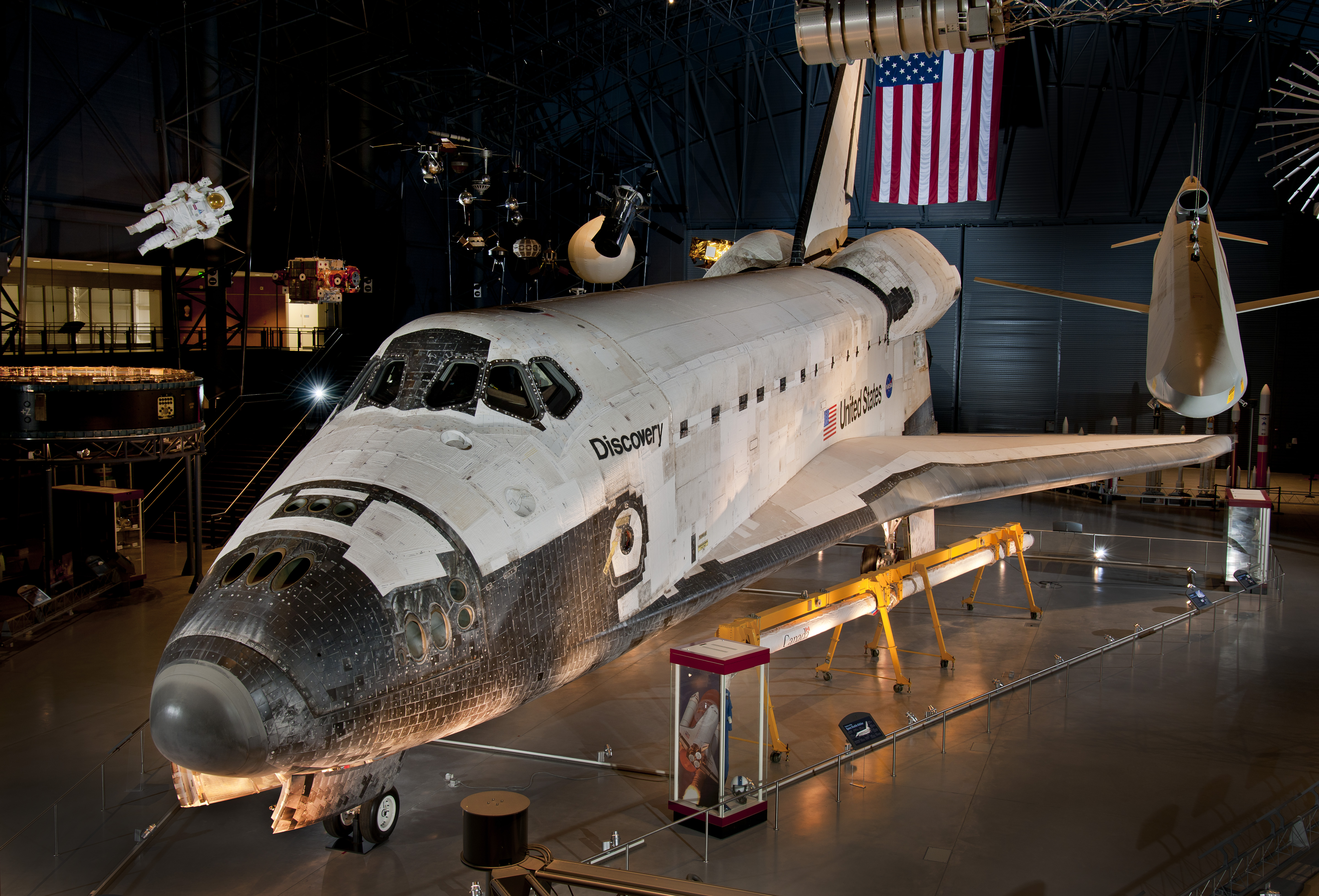
    Space Shuttle orbiter Discovery on display in the McDonnell Space Hangar at the Steven F. Udvar-Hazy Center

    Human Spaceflight

    Space Shuttle orbiter Discovery on display in the McDonnell Space Hangar at the Steven F. Udvar-Hazy Center

    Human Spaceflight

    arrow-up Back to top
    Home
    • Facebook facebook
    • Instagram instagram
    • LinkedIn linkedin
    • YouTube youtube

    • Contact Us
    • Get Involved
    • Shop Online
    • Job Opportunities
    • Equal Opportunity
    • Inspector General
    • Records Requests
    • Accessibility
    • Host Your Event
    • Press Room
    • Privacy
    • Terms of Use