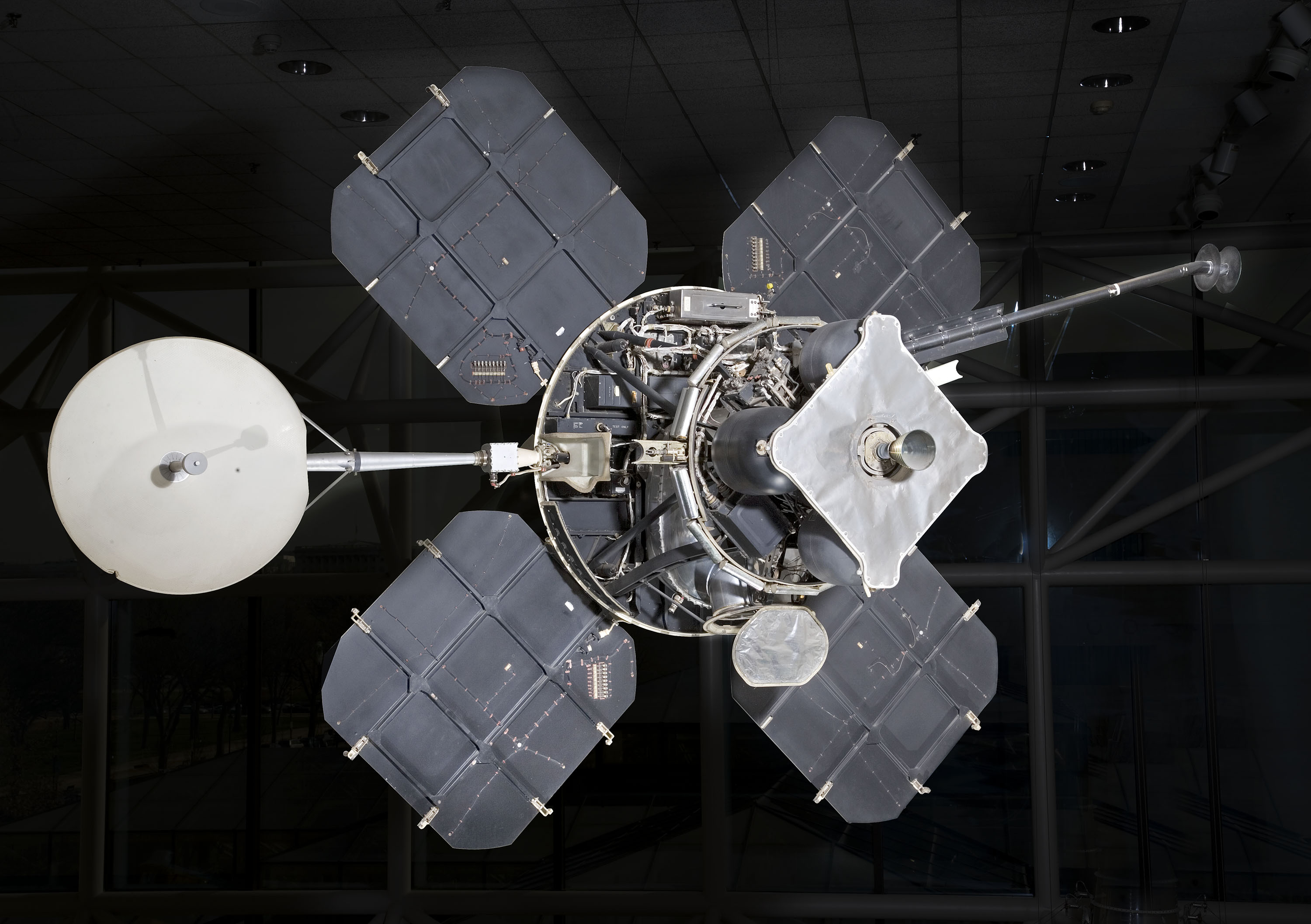
Object Details
Manufacturer
NASA - Jet Propulsion Laboratory
Summary
Mariner Television Camera
A19790898000
This dual television camera system is identical to those flown to Mars on Mariners 6 and 7 in 1969. The two cameras, one of medium resolution (wide angle) and the other of high resolution (narrow angle), were integral to both probe's scientific instrumentation.
NASA's Jet Propulsion Laboratory transferred this artifact to NASM in 1975.
Dimensions: 10 1/4 in. tall x 6 in. wide (26.04 x 15.24cm)
Manufacturer: NASA Jet Propulsion Laboratory
Long Description
Two television vidicon cameras, one of medium resolution (wide angle) and the other of high resolution (narrow angle), were part of both the Mariner 6 and Mariner 7 scientific instrumentation. The wide-angle camera, which had a freedom of view of 11 degrees by 14 degrees and a focal length of 50 mm, encompassed 100 times more surface area than the narrow-angle camera and was used only for near-encounter pictures. The narrow-angle camera, which was used for both near- and far-encounter pictures, had a focal length of 508 mm and provided 10 times the linear resolution of the wide-angle camera. Camera shutters were alternated and timed to provide overlapping of the wide-angle and narrow-angle pictures, providing 126 pictures from the two systems (33 near-encounter and 93 far-encounter). The near-encounter pictures were taken between 20 min 26 s before closest approach and 2 min 6 s after closest approach along a roughly north-south course that intersected the Mariner 6 track and included the Martian south polar cap. The far-encounter pictures were obtained in three series of operations between 68 h and 5 h before closest approach. Two fractional pictures were obtained at the end of the first two series. The picture data were encoded and recorded within the onboard television and data storage subsystems. For each picture produced by the cameras three separate encoded versions were transmitted to earth: a composite analog video (CAV) picture, a digital video (DV) picture, and an every twenty-eighth (ETE) digital picture. Video reconstruction consisted of combining the three data streams (CAV, DV, and ETE). This generated video data as they existed coming out of the camera heads. The telemetered video magnetic tapes were displayed on a CRT and photographed on 70-mm film to produce the raw images. They were also digitally processed by an IBM 360/44 computer for enhancement and by an IBM 360/75 for noise removal to obtain the versions contained in data sets -01C through -01H. Detailed information on the digital processing procedures can be found in T. C. Rindfleish et al., "Digital Processing of the Mariner 6 and 7 Pictures," _Journal of Geophysical Research_ 76 (January 1971): 394-417. Accurate trajectory and related geometrical data can be found in "Mariner Mars 1969 Simulated TV Pictures (Final)," by J. K. Campbell, 1970, which was issued by JPL.
Credit Line
Transferred from the National Aeronautics and Space Administration
Date
1969
Inventory Number
A19790898000
Restrictions & Rights
Usage conditions apply
Type
SPACECRAFT-Uncrewed-Instruments & Payloads
Materials
Metal Alloys
Ferrous Alloy
Ink
Glass
Plastics
Chrome Plating
Gold Plating
Dimensions
3-D (Overall): 26 × 10.2 × 15.2cm (10 1/4 × 4 × 6 in.)
Country of Origin
United States of America
See more items in
National Air and Space Museum Collection
Location
National Air and Space Museum in Washington, DC
Exhibition
Kenneth C. Griffin Exploring the Planets Gallery
Data Source
National Air and Space Museum
Link to Original Record
Record ID
nasm_A19790898000