
Object Details
Manufacturer
Boller & Chivens Company
Summary
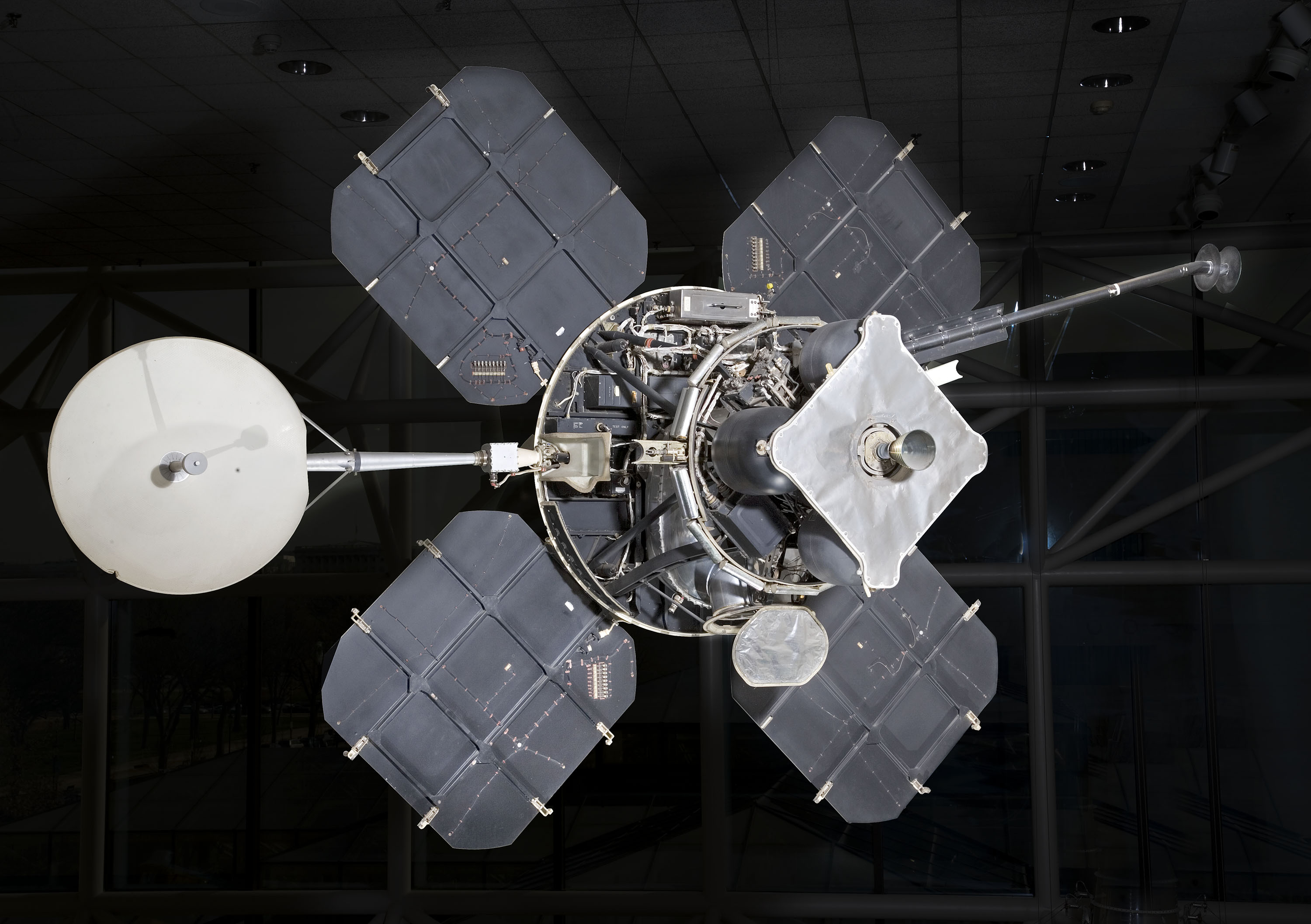
This is the first of one dozen Baker-Nunn wide-field telescopic cameras built for, and used by, the Smithsonian Astrophysical Observatory. In 1958 SAO established a worldwide network of camera stations to photograph satellites slated to be launched during the International Geophysical Year. This, the initial camera, was sited at Organ Pass, NM. It obtained the first civilian photograph of a satellite when it was still being tested at the Boller and Chivens Company in Pasadena, California. The modified Schmidt-type optics and some of the associated mechanical elements were manufactured by Perkin-Elmer while the camera and mounting proper were built by the Boller and Chivens Company. James Baker designed the optics and Joseph Nunn designed and built the mounting.
The Smithsonian Astrophysical Observatory transferred the camera to NASM in December 1980 as part of a general suite of satellite ranging and tracking systems employed by SAO, including a laser-ranging system.
Credit Line
Transferred from the Smithsonian Astrophysical Observatory
Inventory Number
A19840406000
Restrictions & Rights
Usage conditions apply
Type
EQUIPMENT-Photographic
Materials
HAZMAT: Cadmium Plating
Aluminum, Steel, Copper, Foam, Adhesive, Paint, Paper, Phenolic Resin, Wood
Dimensions
Other (base plate): 4ft x 5ft x 1ft 4in., 1250lb. (121.92 x 152.4 x 40.64cm, 567kg)
Other (gimbal ring): 7ft 9in. x 5ft 6in. x 3ft, 2600lb. (236.22 x 167.64 x 91.44cm, 1179.4kg)
Other (corrector cell): 3ft 5in. x 3ft 5in. x 2ft 7in., 900lb. (104.14 x 104.14 x 78.74cm, 408.2kg)
Other (telescope mirror): 4ft 3in. x 4ft 3in. x 2ft 9in., 1950lb. (129.54 x 129.54 x 83.82cm, 884.5kg)
Other (miscellaneous parts): 4ft 2in. x 2ft 5in. x 2ft 4in., 400lb. (127 x 73.66 x 71.12cm, 181.4kg)
Other (camera yoke): 4ft 10in. x 2ft 10in. x 9ft 6in., 1200lb. (147.32 x 86.36 x 289.56cm, 544.3kg)
Other (camera part 1): 2ft 4in. x 2ft 4in. x 2ft 4in. (71.12 x 71.12 x 71.12cm)
Other (camera part 2): 2ft 3in. x 1ft 5in. x 2ft 3in. (68.58 x 43.18 x 68.58cm)
Other (camera part 3): 1ft 10in. x 4ft 5in. x 2ft 4in. (55.88 x 134.62 x 71.12cm)
Other (camera part 4): 3ft x 1ft 9in. x 2ft 6in. (91.44 x 53.34 x 76.2cm)
Other (camera part 5): 3ft 3in. x 2ft x 3ft 4in. (99.06 x 60.96 x 101.6cm)
Other (combined): 8980lb. (4073.3kg)
Country of Origin
United States of America
See more items in
National Air and Space Museum Collection
Data Source
National Air and Space Museum
Link to Original Record
Record ID
nasm_A19840406000