
Object Details
Manufacturer
Hughes Aircraft Co.
Summary
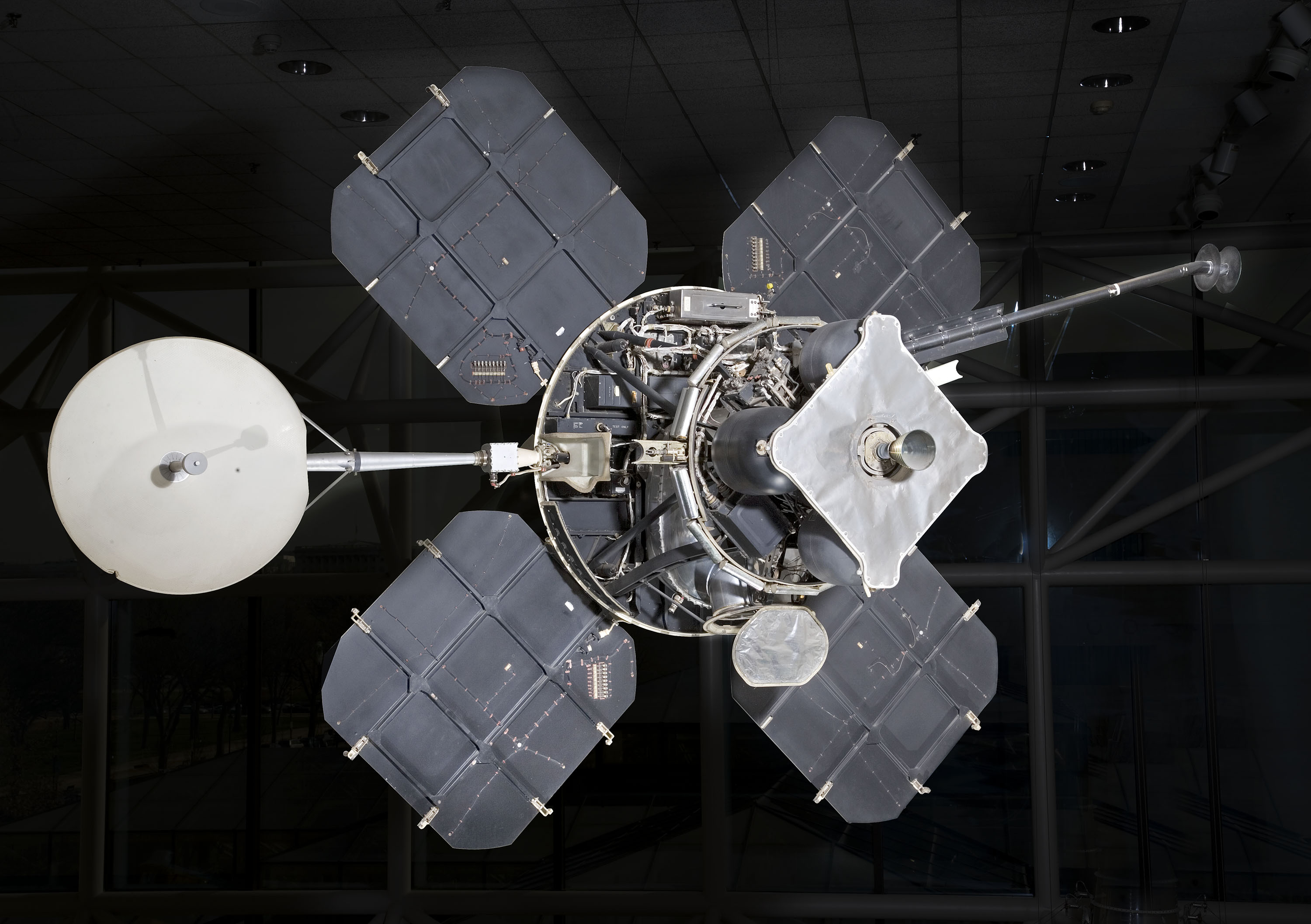
This variable focal length and iris camera assembly was mounted on the Surveyor spacecraft. The iris could be operated in an automatic mode, which was controlled by integrating the scene luminance through a photocell in the lens.
In 1970, the Hughes Aircraft Co. donated the camera to the Smithsonian Institution.
Long Description
This is the variable focal length and iris assembly, which was mounted in the cylinderical lens support structure under the mirror elevation drive assembly in the Survey TV camera on the Surveyor spacecraft. It was responsible for the optical formation of the image on the underlying vidicon faceplate. The lens could vary its focus from 1.23 m to infinity by means of a rotating focus cell. Although the lens was a zoom type, it was calibrated to operate only at 25- or 100-mm focal lengths. These positions correspond to a wide-angle field of view of 25.2 x 25.2 degrees and a narrow-angle field of view of 6.4 x 6.4 degrees, respectively. In the narrow angle mode, the angular resolution of the camera was >0.5 mrad at 15% relative response, which allowed investigators to discriminate objects <1 mm in diameter near the spacecraft footpads (1.6 m from the camera). The iris could be operated by ground commands to give 11 positions for calibration, resulting in the capability of changing the aperture area by a factor of 1.414 to the values of f/4, f/4.8, f/5.6, f/6.7, f/8, f/9.5, f/11, f/13, f/16, f/19, and f/22. The iris could also be operated in an automatic mode, which was controlled by integrating the scene luminance through a photocell in the lens. Potentiometers geared to the iris, focal length, and focus elements allowed readouts of these functions.
Credit Line
Donated by Hughes Aircraft Co.
Inventory Number
A19700116000
Restrictions & Rights
Usage conditions apply
Type
SPACECRAFT-Uncrewed-Instruments & Payloads
Materials
Lens with housing and motors.
Dimensions
3-D (L x W x H) (818g): 17.1 × 15.2 × 7.3cm, 0.8kg (6 3/4 × 6 × 2 7/8 in., 1.8lb.)
Country of Origin
United States of America
See more items in
National Air and Space Museum Collection
Location
Steven F. Udvar-Hazy Center in Chantilly, VA
Exhibit Station
Space Science
Data Source
National Air and Space Museum
Link to Original Record
Record ID
nasm_A19700116000