
Object Details
maker
Burroughs Adding Machine Company
Description
Printing adding machines built on patents of William S. Burroughs of St. Louis sold successfully from the 1890s. The first of these machines printed a single column of figures on a narrow paper tape. By the early 20th century, the Burroughs Adding Machine Company manufactured machines with a wide carriage, suited for printing columns of figures on wider sheets of paper. By 1917, Burroughs sold wide carriage, electrically powered machines that could subtract as well as add. They called them Burroughs Class 6 bookkeeping machines.
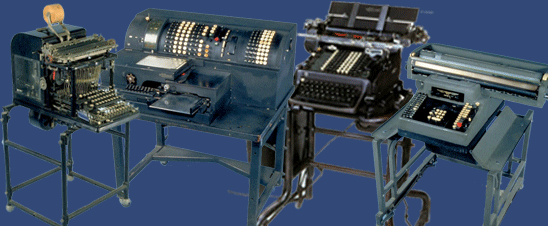
The machine has a metal case and stand, with glass sides. In this example, there are 13 columns of round plastic keys, with nine keys in each column. On the right are eight columns of black and white digit keys, with key color deterined by the place value of the digit represented. Left of these keys are two columns containing a total of fifteen of white keys, with various three-letter designations of types of transactions. Left of these white keys are red keys for designating days of the month and black keys marked with abbreviations for days of the month. The machine also has an operating bar, function keys, and 12 zeroing buttons above the keyboard. A total register visible through the front glass shows eight-digit totals.
A mark on the front glass reads: Burroughs (/) THIS MACHINE PROTECTED BY U.S. AND FOREIGN PATENTS. A metal tag screwed to the bottom front reads: 2932.
At the back are a carriage, paper guide and printing mechanism. The machine is blind printing, which means that numbers printed are not visible to the operator. The motor under the machine is attached to it by a cloth-covered cord. An account printed out on a machine like this one has Museum number MA.308348.1.
The Class 6 came in several models. This appears to be a model 6505 or 6506. This form of machine was replaced by the Burroughs Classes 20 and 30 bookkeeping machines in 1928.
The object was lent to the Smithsonian by Burroughs Adding Machine Company in 1924. It was donated to the Institution by Unisys Corporation in 2011.
Reference:
P. A. Kidwell, “The Adding Machine Fraternity at St. Louis: Creating a Center of Invention, 1880–1920.” IEEE Annals of the History of cComputing, 22 #2 (April–June 2000), pp. 14–17, 472.
Burroughs Corporation Papers, Charles Babbage Institute, University of Minnesota, Minneapolis, Minnesota.
New York Tribune, May 22, 1917, p. 5.
Location
Currently not on view
Credit Line
Gift of Unisys Corporation
date made
1923
ID Number
MA.308348
catalog number
308348
accession number
2011.0264
Object Name
bookkeeping machine on stand
Physical Description
plastic (overall material)
metal (overall material)
glass (overall material)
cloth (overall material)
rubber (overall material)
Measurements
overall: 85 cm x 50 cm x 64 cm; 33 15/32 in x 19 11/16 in x 25 3/16 in
place made
United States: Michigan, Detroit
See more items in
Medicine and Science: Mathematics
Bookkeeping Machines
Science & Mathematics
Data Source
National Museum of American History
Subject
Mathematics
Business
Link to Original Record
Record ID
nmah_694190