
Object Details
Manufacturer
Bristol Aeroplane Company Limited
Designer
Roy Fedden
Physical Description
Type: Reciprocating, 9 cylinders, radial, air cooled
Power rating: 343 kW (460 hp) at 2,000 rpm
Displacement: 28.7 L (1,753 cu in.)
Bore and Stroke: 147.5 mm (5.75 in.) x 190.5 mm (7.5 in.)
Weight (dry): 408 kg (900 lb)
Summary
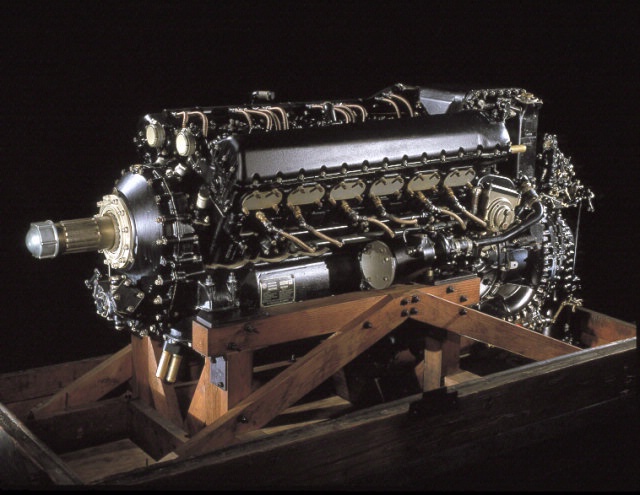
Bristol Jupiter VIIIF
The Jupiter was Great Britain’s most successful high-power, air-cooled engine in the 1920s and ’30s. Bristol Aeroplane acquired the assets of Cosmos Engineering in 1920, which included the Jupiter and its designer, Roy Fedden. The Royal Air Force adopted the Jupiter as its first post–World War I engine in 1923. Bristol and its licensees built more than 7,000 Jupiters for at least 262 different aircraft types.
The Model VIII was the first Jupiter to use reduction gearing, which allowed the engine and propeller to rotate at different speeds for increased efficiency. The Model VIIIF powered the Blackburn B.T. 1 Beagle, Boulton-Paul P.29 Sidestrand III, Handley Page H.P.33 Clive I, Vickers 192 Vildebeest, and Westland Wapiti I, IA, II, and IIA. The “F” denoted a lightweight forged aluminum cylinder head, an important advance in reciprocating engines.
Transferred from the U.S. Navy
Type:reciprocating, 9 cylinders, single-row radial, air cooled
Power rating:343 kW (460 hp) at 2,000 rpm
Displacement:28.7 L (1,753 cu in)
Weight (dry):408 kg (900 lb)
Manufacturer:Bristol Aeroplane Co., Bristol, England
A19710880000
Credit Line
Transferred from the U.S. Navy
Date
1930
Inventory Number
A19710880000
Restrictions & Rights
Usage conditions apply
Type
PROPULSION-Reciprocating & Rotary
Dimensions
Diameter 134.6 cm (53.0 in.), Length 114.3 (45.0 in.)
Country of Origin
United Kingdom
See more items in
National Air and Space Museum Collection
Location
Steven F. Udvar-Hazy Center in Chantilly, VA
Hangar
Boeing Aviation Hangar
Data Source
National Air and Space Museum
Link to Original Record
Record ID
nasm_A19710880000