
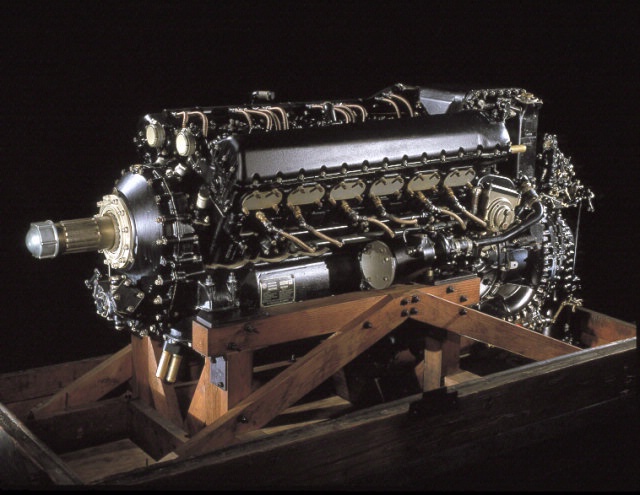
Object Details
Manufacturer
Bristol Aeroplane Company Limited
Physical Description
Type: Reciprocating, sleeve-valve engine, 14 cylinders, 2-row radial, air cooled, supercharged
Power rating: 1,182 kW (1,585 hp) at 2,900 rpm
Displacement: 38.7 L (2,360 cu in.)
Bore and Stroke: 146 mm (5.75 in.) x 165 mm (6.5 in.)
Weight (dry): 858 kg (1,890 lb)
Summary
In 1926 Bristol began studies to integrate the Burt-McCollum sleeve valve concept into selected new engine designs. The sleeve valve, which moved within the cylinders, functioned as both an intake and exhaust valve. Relative to an engine with conventional intake and exhaust valves, the advantages of the sleeve valve design included a lower parts count, operational smoothness, and improved fuel economy.
In March 1935, Roy Fedden and L.F.G. Butler began the design of the Bristol Hercules, the third Bristol engine model to incorporate sleeve valves. After overcoming difficult development problems, the Hercules was produced in larger quantity than any other Bristol engine. This engine, a Model VI, powered World War II aircraft such as the Short S.29 Stirling III, Avro 683 Lancaster II, Handley Page H.P.61 Halifax III, and Bristol 156 Beaufighter. After the war it powered such commercial aircraft as the Vickers 623 Viking IA, Short S.45 Solent 3, and Bristol 170 Freighter.
Credit Line
Gift of the Bucks County Scientific Society of Morrisville, Pennsylvania
Date
1935
Inventory Number
A19580003000
Restrictions & Rights
Usage conditions apply
Type
PROPULSION-Reciprocating & Rotary
Materials
Ferrous Alloy
Aluminum Alloys
Plastic
Paints
Possible Rubber
Cork
Adhesive
Non-Magnetic White Metal
Dimensions
3-D: 182.9 × 142.2 × 133.3cm (6 ft. × 4 ft. 8 in. × 4 ft. 4 1/2 in.)
Overall: 1890lb. (857.3kg)
Storage (Stand): 7 × 5 ft.
Country of Origin
United Kingdom
See more items in
National Air and Space Museum Collection
Data Source
National Air and Space Museum
Link to Original Record
Record ID
nasm_A19580003000