
Object Details
Manufacturer
BMW (Bayerische Motoren Werke)
Physical Description
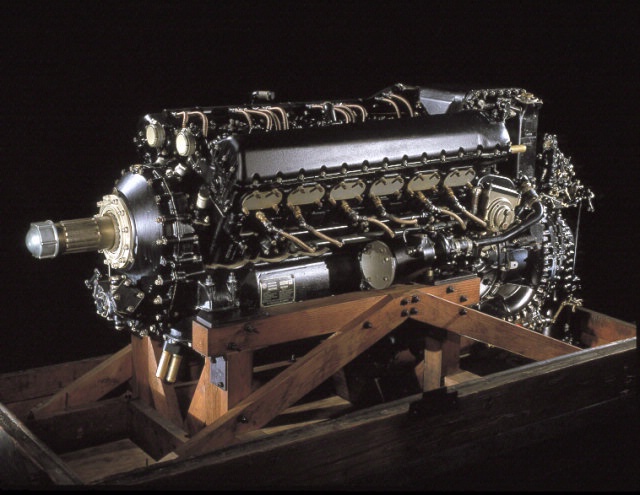
Type: Reciprocating, In-line, 6 cylinders, liquid-cooled,
Power Rating: 134 kW (180 hp) at 1410 rpm
Displacement: 19.058 L (1,163 cu in.)
Bore and Stroke: 150 mm (5.9 in) x 180 mm (7.1 in)
Weight: 293 kg (644 lb)
Summary
The Daimler-Benz company's virtual monopoly on the production of aircraft engines in Germany stifled research and development of other engines. As a result, when the Allies introduced a new generation of high-performance engines in 1916, Germany found itself without a suitable replacement for its now-obsolete standard aircraft power plant, the 119 kw (160-shp) Daimler-Benz Mercedes.
Believing that he had a solution to the crisis, Daimler-Benz designer Max Fritz proposed a new engine that used the same technology as the older Mercedes. But his ideas met with resistance, so Fritz left and joined Bayerische Motoren Werke (BMW). There he designed an engine that retained the 6-cylinder in-line configuration of the earlier Daimler-Benz engines, but was superior in many respects.
The BMW Model IIIa had unusually low fuel consumption and very good performance at high altitudes. This was the result of a choked down carburetor setting and a high compression ratio. It powered such aircraft as the Fokker D VII.
Credit Line
Transferred from the U.S. Navy
Date
1918
Inventory Number
A19710908000
Restrictions & Rights
CC0
Type
PROPULSION-Reciprocating & Rotary
Materials
Metal
Dimensions
3-D: 170.2 × 50.8 × 105.4cm (67 × 20 × 41 1/2 in.)
Support: 65.4 × 106.7 × 50.8cm (25 3/4 in. × 42 in. × 20 in.)
Country of Origin
Germany
See more items in
National Air and Space Museum Collection
Location
National Air and Space Museum in Washington, DC
Exhibition
World War I: The Birth of Military Aviation
Data Source
National Air and Space Museum
Link to Original Record
Record ID
nasm_A19710908000