
Object Details
user
Flaming Flashes
Description (Brief)
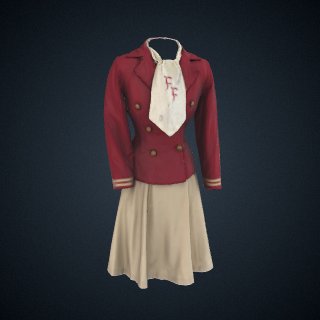
Double breasted, red wool blazer used by a member of the Flaming Flashes, 1934. This was worn with the cream colored scarf and cream colored skirt as a part of the Flaming Flashes uniform of 1934. In 1928, Gussie Nell Davis began her career as a physical education teacher at Greenville High School in Greenville, Texas and immediately saw the need to involve girls in more physical activities. As most sports were not available to girl’s participation, Davis created a pep squad which performed at football games. This evolved into the first high school precision dance and drill team that included dancing and twirling drills and often accompanied by the Greenville band. Davis would move on to Kilgore College where she created another drill team known as the Kilgore Rangerettes, a world renown team that still performs today.
Pep squads were prevalent at high schools and colleges throughout the United States in the early 1900s but it was not until Gussie Nell Davis created the Flaming Flashes that the precision drill team really took hold. Just like pep squads, drill teams were created to promote school spirit and entertain the school and community but drill teams went a step further thanks to Davis’ insight. Seeing the need for girls to build self-confidence and a stronger self-esteem, Davis began teaching dance steps and twirling routines. This not only improved the girl’s physical coordination, it also provided a sense of belonging and community that was lacking, as most team sports were not available to girls. Drill teams are seen primarily in high schools and colleges and perform dance routines in unison, often set to pre-recorded or live music at games or other community events. They differ from cheerleading as they do not cheer or perform jumps and other more athletic stunts. Until Title IX, these precision drill team squads were among the few physical activities available at the high school and collegiate levels that provided opportunities for women.
Location
Currently not on view
date made
1934
ID Number
2015.0249.04
accession number
2015.0249
catalog number
2015.0249.04
Object Name
blazer
blazer, cheerleading
Physical Description
fabric, wool (overall material)
fabric, satin (overall material)
metal (overall material)
Measurements
overall: 24 in x 15 1/2 in; 60.96 cm x 39.37 cm
See more items in
Culture and the Arts: Sport and Leisure
Data Source
National Museum of American History
web subject
Sports
name of sport
Dance Team
level of sport
High School
web subject
Women
Link to Original Record
Record ID
nmah_1801982